MCQ
Two light waves having the same wavelength $\lambda$ in vacuum are in phase initially. Then the first wave travels a path $L _{1}$ through a medium of refractive index $n_{1}$ while the second wave travels a path of length $L_{2}$ through a medium of refractive index $n _{2}$. After this the phase difference between the two waves is:
  • $\frac{2 \pi}{\lambda}\left( n _{1} L _{1}- n _{2} L _{2}\right)$
  • B
    $\frac{2 \pi}{\lambda}\left(\frac{ L _{2}}{ n _{1}}-\frac{ L _{1}}{ n _{2}}\right)$
  • C
    $\frac{2 \pi}{\lambda}\left(\frac{ L _{1}}{ n _{1}}-\frac{ L _{2}}{ n _{2}}\right)$
  • D
    $\frac{2 \pi}{\lambda}\left( n _{2} L _{1}- n _{1} L _{2}\right)$
Answer

Correct option: A.
$\frac{2 \pi}{\lambda}\left( n _{1} L _{1}- n _{2} L _{2}\right)$
a
$\Delta p = n _{1} L _{1}- n _{2} L _{2}$

$\Delta \phi=\frac{2 \pi}{\lambda} \Delta p$

Need a full question paper?

Generate a complete, print-ready paper with questions like this in minutes — across 16+ boards, with answer keys.

Start Generating Free

Similar questions

A uniform meter scale balances at the $40\,cm$ mark when weights of $10\,g$ and $20\,g$ are suspended from the $10\,cm$ and $20\,cm$ marks. The weight of the metre scale is ...... $g$
The only elastic modulus that applies to fluids is
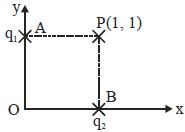
Two point charges $q_1$ and $q_2 (=q_1/2)$ are placed at points $A(0, 1)$ and $B(1, 0)$ as shown in the figure. The electric field vector at point $P(1, 1)$ makes an angle $\theta $ with the $x-$ axis, then the angle $\theta$ is
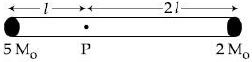
A rigid massless road of length $3l$ has tow masses attached at each end as shown in the figure. The rod is pivoted at point $P$ on the horizontal axis (see figure). When released from initial horizontal position, its instantaneous angular acceleration will be
A monoatomic gas of $n-$moles is heated from temperature $T‌_1$ to $T_2$ under two different conditions $(i)$ at constant volume and $(ii)$ at constant pressure. The change in internal energy of the gas is
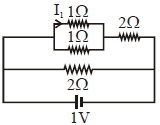
The current $I_{1}$ (in $A$) flowing through $1\; \Omega$ resistor in the following circuit is:
The percentage errors in quantities $P, Q, R$ and $S$ are $0.5\%,\,1\%,\,3\%$ and $1 .5\%$ respectively in the measurement of a physical quantity $A\, = \,\frac{{{P^3}{Q^2}}}{{\sqrt {R}\,S }}$ . the maximum percentage error in the value of $A$ will be $........... \%$
When the temperature of silicon sample is increased from $27^\circ C$ to $100^\circ C$, the conductivity of silicon will be
A big drop of radius $R$ is formed by $729$ small drops of water of radius $r$, then the radius of each small drop will be
Two capacitors of capacitances $3\,\mu \,F$ and $6\,\mu F$ are charged to a potential of $12 \,V$ each. They are now connected to each other, with the positive plate of each joined to the negative plate of the other. The potential difference across each will be......$volt$