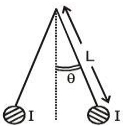
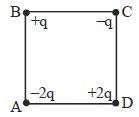
($g =$ gravitational acceleration)
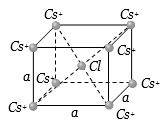

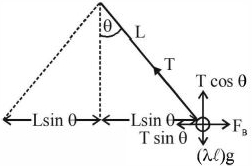
At equilibrium
$\mathrm{T} \cos \theta=\lambda \mathrm{g} \ell$
and $T \sin \theta=\frac{\mu_{0}}{2 \pi} \frac{I \times I l}{2 L \sin \theta}\left[\because \frac{F_{B}}{\ell}=\frac{\mu_{0}}{4 \pi} \frac{2 I \times I}{2 \ell \sin \theta}\right]$
Therefore, $I=2 \sin \theta \sqrt{\frac{\pi \lambda g L}{u_{0} \cos \theta}}$
Generate a complete, print-ready paper with questions like this in minutes — across 16+ boards, with answer keys.


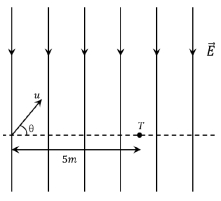
$(A)$ the particle will hit $T$ if projected at an angle $45^{\circ}$ from the horizontal
$(B)$ the particle will hit $T$ if projected either at an angle $30^{\circ}$ or $60^{\circ}$ from the horizontal
$(C)$ time taken by the particle to hit $T$ could be $\sqrt{\frac{5}{6}} \mu s$ as well as $\sqrt{\frac{5}{2}} \mu s$
$(D)$ time taken by the particle to hit $T$ is $\sqrt{\frac{5}{3}} \mu s$