Question
Two long straight parallel conductors carry steady current $I_1$ and $I_2$ separated by a distance d. If the currents are flowing in the same direction, show how the magnetic field set up in one produces an attractive force on the other. Obtain the expression for this force. Hence define one ampere.
Answer


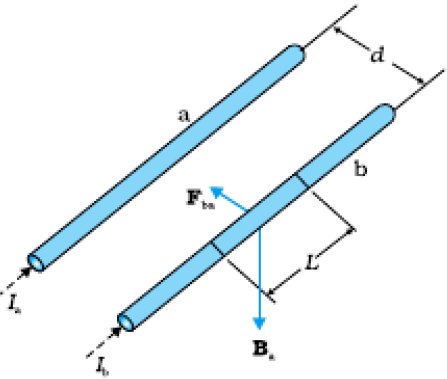
As shown in Figure, the direction of force on conductor b is attractive.
Alternate Answer
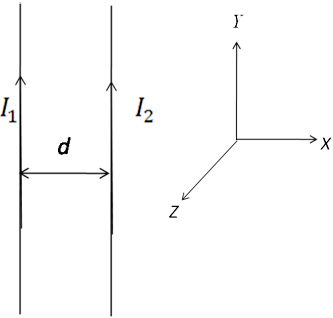
$\overrightarrow{\text{B}}$at a point on wire 2, is along - $\hat{\text{k}}$
$\therefore\overrightarrow{\text{F}} , $ on wire 2, due to the $\overrightarrow{\text{B}}$ is along - $\hat{\text{i}}$ i.e.towards wire1. Hence the force is attractive.

Magnetic field, due to current in conductor a,
$\text{B}_{1} = \frac{\mu_\circ\text{I}_{1}}{2\pi\text{d}}$
The magnitude of force on a length L of conductor b,
$\text{F}_{2} = \text{I}_{2}\text{LB}_{1}$
$\text{F}_{2} =\frac{\mu_\circ\text{I}_{1}\text{I}_{2}\text{L}}{2\pi\text{d}}$
One ampere is that steady current which, when maintained in each of the two very long, straight, parallel conductors, placed one meter apart in vacuum, would produce on each of these conductors a force equal to $2 \times10^{-7}$ newton per meter of their length.

Need a full question paper?

Generate a complete, print-ready paper with questions like this in minutes — across 16+ boards, with answer keys.

Start Generating Free

Similar questions

Are matter waves electromagnetic?
Find the magnetic field B due to a semicircular wire of radius 10.0cm carrying a current of 5.0A at its centre of curvature.
Explain the process of thermonuclear fusion with example.
You have learnt in the text how Huygens’ principle leads to the laws of reflection and refraction. Use the same principle to deduce directly that a point object placed in front of a plane mirror produces a virtual image whose distance from the mirror is equal to the object distance from the mirror.
One end of a spring of natural length h and spring constant k is fixed at the ground and the other is fitted with a smooth ring of mass m which is allowed to slide on a horizontal rod fixed at a height h (figure). Initially, the spring makes an angle of 37° with the vertical when the system is released from rest. Find the speed of the ring when the spring becomes vertical.
Mass of a particle depends on its speed. Does the attraction of the earth on the particle also depend on the particle's speed?
A spherical shell made of plastic, contains a charge Q distributed uniformly over its surface. What is the electric field inside the shell? If the shell is hammered to deshape it without altering the charge, will the field inside be changed? What happens if the shell is made of a metal?
The normal activity of living carbon-containing matter is found to be about 15 decays per minute for every gram of carbon. This activity arises from the small proportion of radioactive $ ^{14}_6\text{C}$ present with the stable carbon isotope $^{12}_6\text{C}.$ When the organism is dead, its interaction with the atmosphere (which maintains the above equilibrium activity) ceases and its activity begins to drop. From the known half-life (5730 years) of $^{14}_6\text{C },$ and the measured activity, the age of the specimen can be approximately estimated. This is the principle of $^{14}_6\text{C}$ datingused in archaeology. Suppose a specimen from Mohenjodaro gives an activity of 9 decays per minute per gram of carbon. Estimate the approximate age of the Indus-Valley civilisation.
A block of mass 0.5kg hanging from a vertical spring executes simple harmonic motion of amplitude 0.1m and time period 0.314s. Find the maximum force exerted by. the spring on the block.
Draw the graph to show variation of binding energy per nucleon with mass number of different atomic nuclei. Calculate binding energy/nucleon of $^{40}_{20}\text{Ca}$ nucleus.
Given:
mass of $^{40}_{20}\text{Ca} = 39.962589\text{u}$.
mass of proton $= 1.007825$ u.
mass of neutron $= 1.008665$ u.
and $1\ u = 931\ MeV/C^{2.}$