Question
Two long strings A and B, each having linear mass density 1.2 x 10⁻²kg/m, are stretched by different tensions 4.8N and 7.5N respectively and are kept parallel to each other with their left ends at x = 0. Wave pulses are produced on the strings at the left ends at t = 0 on string A and at t = 20ms on string B. When and where will the pulse on B overtake that on A?
Answer

$\text{m}_\text{A}=1.2\times10^{-2}\text{kg/m},\ \text{T}_\text{A}=4.8\text{N}$

$\Rightarrow\text{v}_\text{A}=\sqrt{\frac{\text{T}}{\text{m}}}=20\text{m/s}$

$\text{m}_\text{B}=1.2\times10^{-2}\text{kg/m},\ \text{T}_\text{B}=7.5\text{N}$

$\Rightarrow\text{V}_\text{B}=\sqrt{\frac{\text{T}}{\text{m}}}=25\text{m/s}$

$\text{t}=0$ in string A

$\text{t}_1=0+20\text{ms}=20\times10^{-3}=0.02\text{sec}$

In 0.02 sec A has travelled $20\times0.02=0.4\text{mt}$

Relative speed between A and B $=25-20=5\text{m/s}$

Time taken for B for overtake A $=\frac{\text{s}}{\text{v}}=\frac{0.4}{5}=0.08\text{sec}$

Need a full question paper?

Generate a complete, print-ready paper with questions like this in minutes — across 16+ boards, with answer keys.

Start Generating Free

Similar questions

Distinguish between nuclear fission and fusion. Show how in both these processes energy is released. Calculate the energy release in MeV in the deuterium-tritium fusion reaction:
$^{2}_{1}\text{H} + ^{3}_{1}\text{H}\rightarrow^{4}_{2}\text{H} +\text{n}$
Using the data:
$\text{m}(^{2}_{1}\text{H}) = 2.014102 \text{u}$
$\text{m}(^{3}_{1}\text{H}) = 3.016049\text{u}$
$\text{m}(^{4}_{2}\text{H}) = 4.002603 \text{u}$
$\text{m}_{n} = 1.008665 \text{n}$
$1\text{u} = 931.5\text{MeV/c}^{2}$.
Draw a plot showing the variation of power of a lens with the wavelength of the incident light.
What is reverse bias? Explain the change occuring in the junction under the effect of reverse bias.
A series LCR circuit is connected to an ac source. Using the phasor diagram, derive the expression for the impedance of the circuit. Plot a graph to show the variation of current with frequency of the source, explaining the nature of its variation.
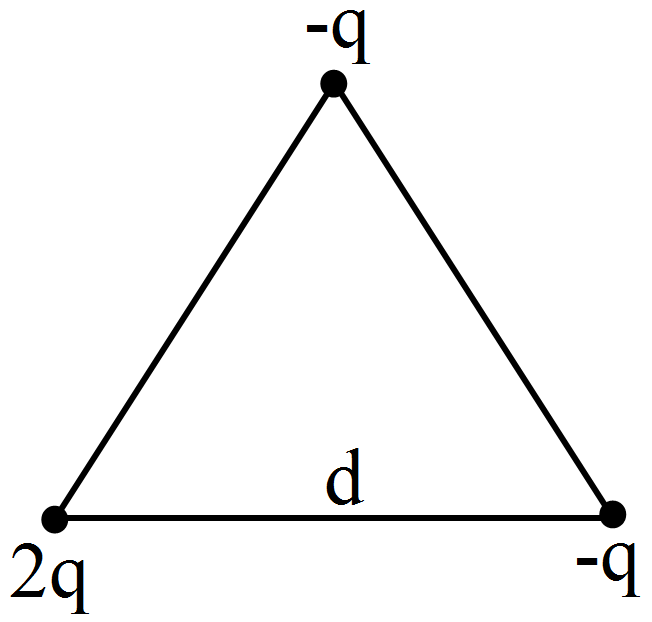
Three charges are arranged on the vertices of an equilateral triangle as shown in figure. Find the dipole moment of the combination.

The near point and the far point of a child are at 10cm and 100cm. If the retina is 2.0cm behind the eye-lens, what is the range of the power of the eye-lens?
One end of a cylindrical glass rod $(\mu=1.5)$ of radius 1.0cm is rounded in the shape of a hemisphere. The rod is immersed in water $\Big(\mu=\frac{4}{3}\Big)$ and an object is placed in the water along the axis of the rod at a distance of 8.0cm from the rounded edge. Locate the image of the object.
Consider three charges $q_1, q_2, q_3$ each equal to $q$ at the vertices of an equilateral triangle of side $l$. What is the force on a charge $Q$ (with the same sign as q) placed at the centroid of the triangle, as shown in Fig. 1.6?
Image
AB is a potentiometer wire (Fig). If the value of R is increased, in which direction will the balance point J shift?

When a capacitor is connected in series LR circuit, the alternating current flowing in the circuit increases. Explain why.