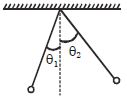
Two masses, both equal to $100\, g$, are suspended at the ends of identical light strings of length $\lambda = 1.0\, m$, attached to the same point on the ceiling (see figure). At time $t = 0$, they are simultaneously released from rest, one at angle $\theta_1 = 1^o$, the other at angle $\theta_2 = 2^o$ from the vertical. The masses will collide
Diffcult


Download our appand get started for free
Experience the future of education. Simply download our apps or reach out to us for more information. Let's shape the future of learning together!No signup needed.*
Similar Questions
- 1A particle executes $SHM$ on a straight line path. The amplitude of oscillation is $2\, cm.$ When the displacement of the particle from the mean position is $1\, cm,$ the numerical value of magnitude of acceleration is equal to the numerical value of magnitude of velocity. The frequency of $SHM$ (in $second^{-1}$) is :View Solution
- 2If a spring has time period $T$, and is cut into $n$ equal parts, then the time period of each part will beView Solution
- 3When a mass $M$ is attached to the spring of force constant $k$, then the spring stretches by $l$. If the mass oscillates with amplitude $l$, what will be maximum potential energy stored in the springView Solution
- 4A body is executing simple harmonic motion with an angular frequency $2\,rad/s$. The velocity of the body at $20\, mm$ displacement, when the amplitude of motion is $60\, mm$, is ...... $mm/s$View Solution
- 5A particle of mass $m$ is performing linear simple harmonic motion. Its equilibrium is at $x = 0,$ force constant is $K$ and amplitude of $SHM$ is $A$. The maximum power supplied by the restoring force to the particle during $SHM$ will beView Solution
- 6Two bodies performing $SHM$ have same amplitude and frequency. Their phases at a certain instant are as shown in the figure. The phase difference between them isView Solution
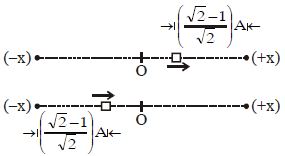
- 7Two simple harmonic motions are represented by the equations ${y_1} = 0.1\sin \left( {100\pi t + \frac{\pi }{3}} \right)$ and ${y_2} = 0.1\cos \pi t.$ The phase difference of the velocity of particle $1$ with respect to the velocity of particle $2$ isView Solution
- 8The particle executing $SHM$ of amplitude $'a'$ has displacement $-\frac {a}{2}$ at $t = \frac {T}{4}$ and a positive velocity. Find the initial phase of particleView Solution
- 9A $S.H.M.$ is represented by $x = 5\sqrt 2 (\sin 2\pi t + \cos 2\pi t).$ The amplitude of the $S.H.M.$ is .... $cm$View Solution
- 10A simple pendulum of mass $m$ executes $S.H.M.$ with total energy $E$. If at an instant it is at one of extreme positions, then its linear momentum after a phase shift of $\frac{\pi}{3} \,rad$ will beView Solution