MCQ
Two metal strips that constitute a thermostat must necessarily differ in their:
  • A
    resistivity
  • B
    length
  • C
    mass
  • D
    coefficient of linear expansion

Answer

D. coefficient of linear expansion
Explanation:
For metallic strip to bend on change in temperature the coefficient of linear expansion should be different.

Need a full question paper?

Generate a complete, print-ready paper with questions like this in minutes — across 16+ boards, with answer keys.
Start Generating Free

Similar questions

A ball is dropped from a height $h$. If the coefficient of restitution be $e$, then to what height will it rise after jumping twice from the ground
A solenoid of $1.5$ $metre$ length and $4.0\, cm$ diameter posses $10$ $turn$ per $cm$. A current of $5$ $ampere$ is flowing through it. The magnetic induction at axis inside the solenoid is
A particle undergoes uniform circular  motion. About which point on the plane of the circle,  will the angular momentum of the particle remain conserved ?
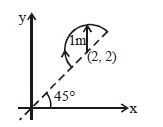
A uniform magnetic field $\vec B = \left( {3\hat i + 4\hat j + \hat k} \right)$ exists in region of space. A semicircular wire of radius $1\,m$ carrying current $1\,A$ having its centre at $(2, 2, 0)$ is placed in $x-y$ plane as shown in figure. The force on semicircular wire will be
Two waves are propagating along a taut string that coincides with the $x-$axis. The first wave has the wave function $y_1 = A cos [k(x - vt)]$ and the second has the wave function $y = A cos [k(x + vt) + \phi ]$.
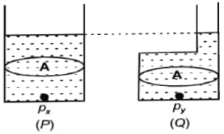
Figure shows two containers $P$ and $Q$ with same base area $A$ and each filled upto same height with same liquid. Select the correct alternative .............
Lenz's law is consequence of the law of conservation of
The radius of two metallic spheres $A$ and $B$ are ${r_1}$ and ${r_2}$ respectively $({r_1} > {r_2})$. They are connected by a thin wire and the system is given a certain charge. The charge will be greater
The molar specific heats of an ideal gas at constant pressure and volume are denoted by $C _{ P }$ and $C _{ V }$ respectively. If $\gamma=\frac{C_{p}}{C_{V}}$ and $R$ is the universal gas constant, then $C _{ V }$ is equal to
A mass $m = 1.0\,kg$ is put on a flat pan attached to a vertical spring fixed on the ground. The mass of the spring and the pan is negligible. When pressed slightly and released, the mass executes simple harmonic motion. The spring constant is $500\,N/m.$ What is the amplitude $A$ of the motion, so that the mass $m$ tends to get detached from the pan ? (Take $g = 10\,m/s^2$ ). The spring is stiff enough so that it does not get distorted during the motion.