MCQ
Two mutually perpendicular simple harmonic vibrations have same amplitude, frequency and phase. When they superimpose, the resultant form of vibration will be
  • A
    A circle
  • B
    An ellipse
  • A straight line
  • D
    A parabola

Answer

Correct option: C.
A straight line
c
(c) If ${y_1} = {a_1}\sin \omega \,t$ and ${y_2} = {a_2}\sin (\omega \,t + 0) = {a_2}\sin \omega \,t$
==> $\frac{{y_1^2}}{{a_1^2}} + \frac{{y_2^2}}{{a_2^2}} - \frac{{2{y_1}{y_2}}}{{{a_1}{a_2}}} = 0$

==> ${y_2} = \frac{{{a_2}}}{{{a_1}}}{y_1}$
This is the equation of straight line.

Need a full question paper?

Generate a complete, print-ready paper with questions like this in minutes — across 16+ boards, with answer keys.
Start Generating Free

Similar questions

Speed of two identical cars are $u$ and $4u$ at a specific instant. The ratio of the respective distances in which the two cars are stopped from that instant is
A liquid is kept in a closed vessel. If a glass plate (negligible mass) with a small hole is kept on top of the liquid surface, then the vapour pressure of the liquid is the vessel is
If T is the total time of flight, $h$ is the maximum height $ \& R$ is the range for horizontal motion, the $x$ and $y$ co-ordinates of projectile motion and time $t$ are related as
In suspended type moving coil galvanometer, quartz suspension is used because
A uniform sphere of mass $500\,g$ rolls without slipping on a $p$ lane surface so that its centre moves at speed of $0.002\,m / s$.The total kinetic energy of rolling sphere would be (in $J$)
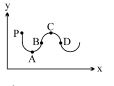
A man moves in $x-y$ plane along the path shown. At what point is his average velocity vector in the same direction as his instantaneous velocity vector. The man starts from point $P$.
The diameter and height of a cylinder are measured by a meter scale to be $12.6 \pm 0.1\, cm$ and $34.2  \pm  0.1\, cm$, respectively. What will be the value of its volume in appropriate significant figures?
Inside a uniform spherical shell

$(a)$ the gravitational field is zero

$(b)$ the gravitational potential is zero

$(c)$ the gravitational field is same everywhere

$(d)$ the gravitation potential is same everywhere

$(e)$ all of the above

Choose the most appropriate answer from the options given below

A source of sound is moving with constant velocity of $20\, m/s$ emitting a note of frequency $1000 \,Hz.$ The ratio of frequencies observed by a stationary observer while the source is approaching him and after it crosses him will be

(Speed of sound $v = 340\, m/s$)

$A$ particle of mass $0.5\, kg$ is rotating in a circular path of radius $2m$ and centrepetal force on it is $9$ Newtons. Its angular momentum (in $J·sec$) is: