Question
Two objects having equal masses are moving with uniform velocities of $2m/s$ and $6m/s$ respectively. Calculate the ratio of their kinetic energies.

Answer

Let masses of the two objects be $m.$
$\text{v}_1 = 2\text{m}/\text{s}$
$\text{v}_2 = 6\text{m}/\text{s}$
$\text{KE}_1=\frac{1}{2}\text{m}\times\text{v}_1^2$
$=\frac{1}{2}\text{m}\times2^2$
$\text{KE}_2=\frac{1}{2}\text{m}\times\text{v}_2^2$
$=\frac{1}{2}\text{m}\times6^2$
$\text{Ratio}=\frac{\text{KE}_1}{\text{KE}_2}$
$=\frac{2^2}{6^2}=\frac{4}{36}=\frac{1}{9}$

Need a full question paper?

Generate a complete, print-ready paper with questions like this in minutes — across 16+ boards, with answer keys.
Start Generating Free

Similar questions

With the help of flow chart depict five kingdoms classification.
$A, B$ and $C$ are all liquids. Liquid $A$ has a comparatively low boiling point. On heating, liquid a vaporizes completely without leaving behind any residue. Liquid $A$ is being used increasingly as a fuel in motor vehicles either alone or by mixing with petrol. Liquid $B$ has a very high boiling point. It also vaporizes completely on heating, without leaving any residue. Liquid $B$ is a conductor of electricity and used in making thermometers. Liquid $c$ has a moderate boiling point. On heating, liquid $C$ vaporises leaving behind a white solid $D$ which is used in cooking vegetables. The condensation of vapours from $C$ give a liquid $E$ which turns anhydrous $\mathrm{CuSO}_4$ to blue.
  1. Which liquid could be an element? Name this element.
  2. Which liquid could be a mixture? Name this mixture.
  3. Which liquid could be a compound? Name this compound.
  4. What could the solid $D$ be?
  5. What do you think is liquid $E$?
Explain the general characters of phylum Mollusca. Give one exarnple of following classes of Mollusca; (i) Gastropoda; (ii) Pelecpoda; (iii) Cephalopoda.
Explain the importance of classification. State two differences between Gymnosperms and Angiosperms. What are the important phylums of Plant kingdom, give their names only? Write the names of the animals of the following phylums to which they belong:
  1. Porifera.
  2. Coelenterata.
  3. Annelida.
  4. Mollusca.
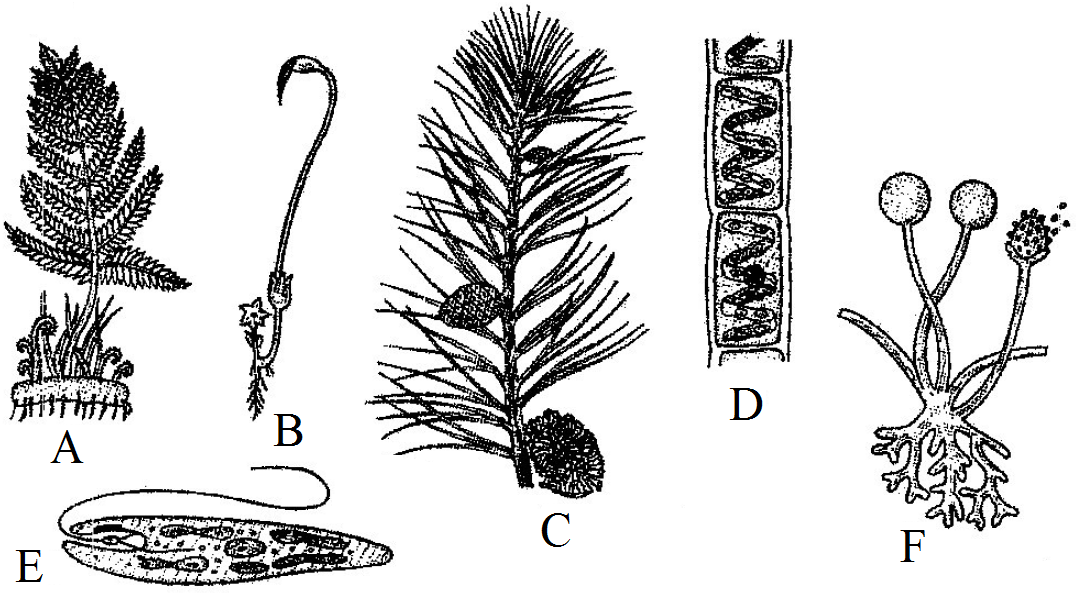
  1. Dentify figures $A$ to $F?$
  2. What is the phylum of $D, E$ and $F?$
  3. What is the division of $A, B,$ and $C?$
  4. Which of them is unicellular and eularyotic organism$?$
  5. Which one of them exhibits $(i)$ Heterotrophic nutrition; $(ii)$ Micotrophic nutririon.
  6. Which one of them is multicellular decomposer$?$
  7. Which one amphibian of plant kingdom?
  8. In which one of them play xylem lacks vessels and phloem is without companion cells$?$
  9. What is the scientific name of esch of them: $(i)$ Male shield fern; $(ii)$ Bread mould$?$
  10. In which of them endosperm is haploid$?$
Describe the various steps involved in the separation of iodine, iron filings and salt from a mixture.
Define connective tissue. Write down functions of connective tissue.
Explain water cycle in detail.
Write down four characters of Osteichthyes and give two examples.
State and explain Kepler’s laws of planetary motion. Draw diagrams to illustrate these laws.