MCQ
Two oscillating systems; a simple pendulum and a vertical spring-mass-system have same time period of motion on the surface of the Earth. If both are taken to the moon, then-
  • Time period of the simple pendulum will be more than that of the spring-mass system.
  • B
    Time period of the simple pendulum will be equal is that is of the spring-mass system.
  • C
    Time period of the simple pendulum will be less than of the spring-mass system.
  • D
    Nothing can be said definitely without observation.
Answer

Correct option: A.
Time period of the simple pendulum will be more than that of the spring-mass system.
a
(a)

For simple pendulum: $T =2 \pi \sqrt{\frac{\ell}{ g }}$ As g will decrease on moon, time period will increase

For spring mass system : $T=2 \pi \sqrt{\frac{m}{k}}$

It will not change and remains the same

Need a full question paper?

Generate a complete, print-ready paper with questions like this in minutes — across 16+ boards, with answer keys.

Start Generating Free

Similar questions

A particle is projected from ground at an angle $\theta$ with horizontal with speed $u$. The ratio of radius of curvature of its trajectory at point of projection to radius of curvature at maximum height is ........
Two blocks of masses $5 \,kg$ and $2 \,kg$ are connected by a spring of negilible mass and placed on a frictionless horizontal surface. An impulse gives a velocity of $7 \,m / s$ to the heavier block in the direction of the lighter block. The velocity of the centre of mass is ....... $m / s$
What is the velocity of a metallic ball of radius $r$ falling in a tank of liquid at the instant when its acceleration is one half that of a freely falling body? $($The densities of metal and of liquid are $\rho$ and $\sigma$ respectively and of viscosity of liquid is $\eta)$
The moment of inertia of a uniform semicircular wire of mass $m$ and radius $r$, about an axis passing through its centre of mass and perpendicular to its plane is ..........
A uniform string oflength $20\ m$ is suspended from a rigid support. A short wave pulse is introduced at its lowest end. It starts moving up the string. The time taken to reach the supports is (take $g= 10 $ $ms^{-2}$ )
A river is flowing from west to east at a speed of 5 metres per minute. A man on the south bank of the river, capable of swimming at 10 metres per minute in still water, wants to swim across the river in the shortest time. He should swim in a direction:
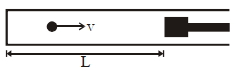
A small particle of mass $m$ moving inside a heavy, hollow and straight tube along the tube axis undergoes elastic collision at two ends. The tube has no friction and it is closed at one end by a flat surface while the other end is fitted with a heavy movable flat piston as shown in figure. When the distance of the piston from closed end is $L = L _0$ the particle speed is $v = v _0$. The piston is moved inward at a very low speed $V$ such that $V \ll \frac{ dL }{ L } v _0$, where $dL$ is the infinitly small displacement of the piston. Which of the following statement($s$) is/are correct?

$(1)$ The rate at which the particle strikes the piston is $v / L$

$(2)$ After each collision with the piston, the particle speed increases by $2 V$

$(3)$ The particle's kinetic energy increases by a factor of $4$ when the piston is moved inward from $L _0$ to $\frac{1}{2} L _0$

$(4)$ If the piston moves inward by $d L$, the particle speed increases by $2 v \frac{d L}{L}$

A rigid bar of mass $M$ is supported symmetrically by three wires each of length $l.$ Those at each end are of copper and the middle one is of iron. The ratio of their diameters, if each is to have the same tension, is equal to
Consider two containers $A$ and $B$ containing identical gases at the same pressure, volume and temperature. The gas in container $A$ is compressed to half of its original volume isothermally while the gas in container $B$ is compressed to half of its original value adiabatically. The ratio of final pressure of gas in $B$ to that of gas in $A$ is
A man standing on a road hold his umbrella at $30^° $ with the vertical to keep the rain away. He throws the umbrella and starts running at $10\, km/hr$. He finds that raindrops are hitting his head vertically, the speed of raindrops w.r.t. the moving man, will be