Question
✓
Answer
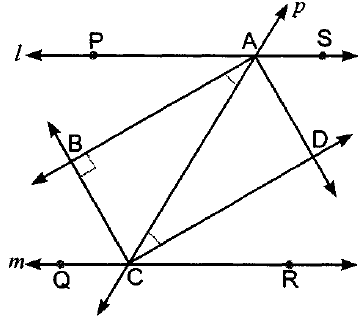
Here, it is given that QR $\parallel$ PS and transversal p intersects them at points A and C respectively.
The bisectors of $\angle$ACR and $\angle$SAC intersect at D and the bisectors of $\angle$PAC and $\angle$ACQ intersect at B.
We have to prove that quadrilateral ABCD is a rectangle.
From the given figure, we have
$\angle$PAC = $\angle$ACR [Alternate angles as l $\parallel$ m and p is a transversal]
So, $\frac{1}{2}$$\angle$PAC = $\frac{1}{2}$$\angle$ACR
i.e., $\angle$BAC = $\angle$ACD
These form a pair of alternate angles for lines AB and DC with AC as a transversal and they are equal also.
So, AB $\parallel$ DC
Similarly, BC $\parallel$ AD [Considering $\angle$ACB and $\angle$CAD]
Therefore, quadrilateral ABCD is a parallelogram
Also, $\angle$PAC + $\angle$CAS = 180o [ by the property of Linear pair ]
So, $\frac{1}{2}$$\angle$PAC + $\frac{1}{2}$$\angle$CAS = $\frac{1}{2}$ $\times$ 180o = 90o
or, $\angle$BAC + $\angle$CAD = 90o
or, $\angle$BAD = 90o
So, ABCD is parallelogram in which one angle ( $\angle$BAD ) is 90o.
Therefore, ABCD is a rectangle.
Need a full question paper?
Generate a complete, print-ready paper with questions like this in minutes — across 16+ boards, with answer keys.
Explore more
Similar questions
Construct a triangle whose perimeter is 6.4cm, and angles at the base are 60° & 45°.
A, B and C are three points on a circle. Prove that the perpendicular bisectors of AB, BC and CA are concurrent.
P is the mid-point of side BC of a parallelogram ABCD such that $\angle\text{BAP}=\angle\text{DAP}$ Prove that AD = 2CD.
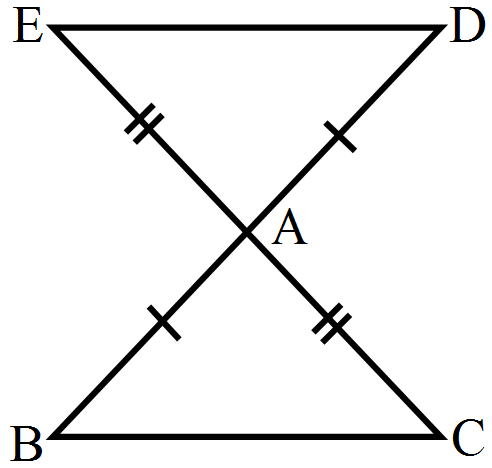
→In Fig. the sides BA and CA have been produced such that: BA = AD and CA = AE. Prove that segment DE || BC.
Locate $\sqrt{3}$ on the number line.
→Three coins are tossed simultaneously 200 times with the following frequencies of different outcomes:
Find the probability of getting at most two heads.
| Outcome | 3 heads | 2 heads | 1 head | No head |
| Frequency | 23 | 72 | 77 | 28 |
How many metres of cloth, 2.5m wide, will be required to make a conical tent whose base radius is 7m and height 24m? $\Big(\text{Use}\ \pi=\frac{22}{7}\Big).$
→Draw a histogram of the following distribution:
| Heights (in cm) | Number of students |
| 150-153 153-156 156-159 159-162 162-165 165-168 | 7 8 14 10 6 5 |
Heights (in cm) of 30 students of class IX are given below:
155, 158, 154, 158, 160, 148, 149, 150, 153, 159, 161, 148, 157, 153, 157, 162, 159, 151, 154, 156, 152, 156, 160, 152, 147, 155, 163, 155, 157, 153.
Prepare a frequency distribution table with 160-164 as one of the class intervals.
155, 158, 154, 158, 160, 148, 149, 150, 153, 159, 161, 148, 157, 153, 157, 162, 159, 151, 154, 156, 152, 156, 160, 152, 147, 155, 163, 155, 157, 153.
Prepare a frequency distribution table with 160-164 as one of the class intervals.
Using factor theorem, factorize the following polynomials:
x3 + 6x2 + 11x + 6
x3 + 6x2 + 11x + 6