Question
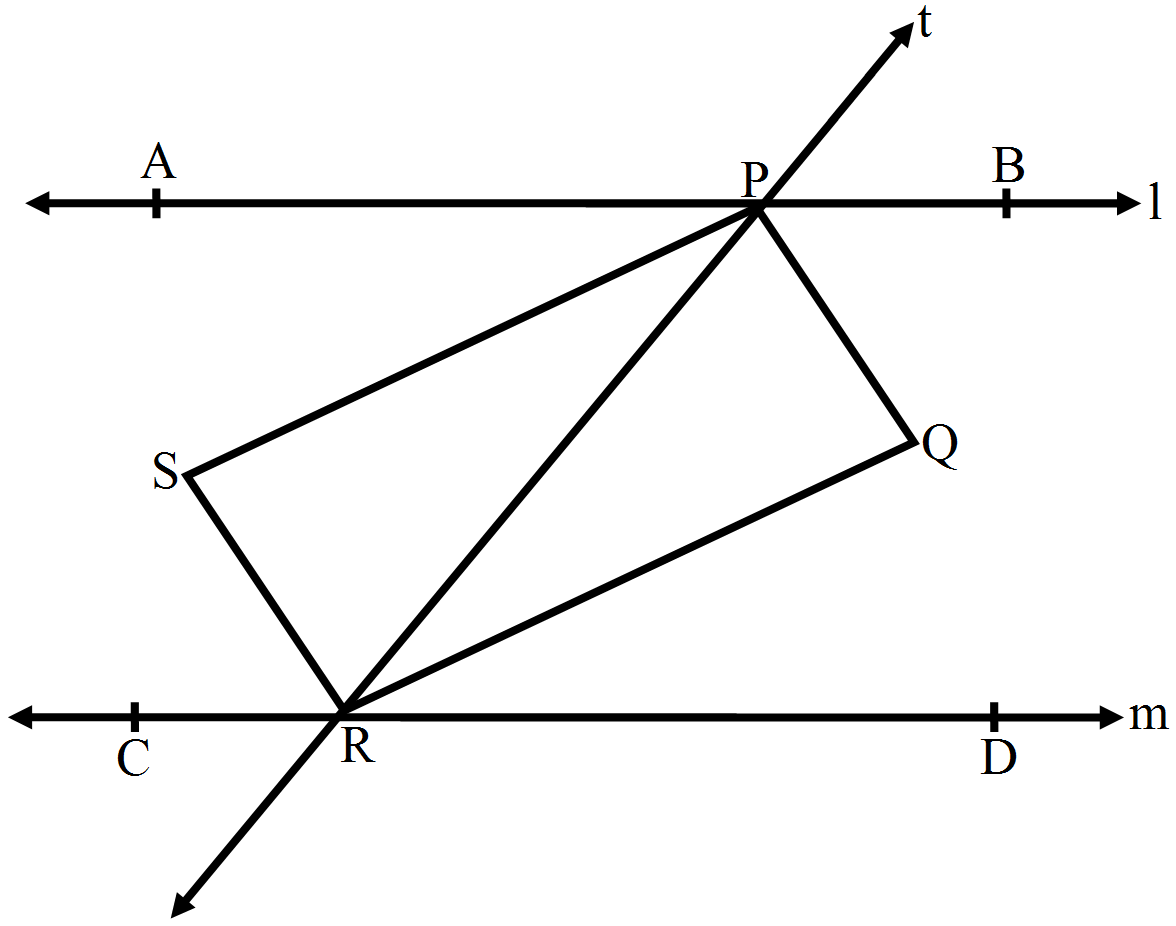
Two parallel lines $l$ and $m$ are intersected by a transversal $t$. Show that the quadrilateral formed by the bisectors of interior angles is a rectangle.
Answer


$l || m$ and $t$ is a transversal.
$\Rightarrow\angle\text{APR}=\angle\text{PRD}$ (alternate angles)
$\Rightarrow\frac{1}{2}\angle\text{APR}=\frac{1}{2}\angle\text{PRD}$
 $\Rightarrow\angle\text{SPR}=\angle\text{PRQ}$ ($PS$ and $RQ$ are the bisectors of $\angle\text{APR}$ and $\angle\text{PRD}$)
Thus, $PR$ intersects $PS$ and $RQ$ at $P$ and $R$ respectively such that $\angle\text{SPR}=\angle\text{PRQ}$ i.e., alternate angles are equal. $\Rightarrow\text{PS\ ||\ RQ}$ Similarly, we have $\text{SR ∥ PQ.}$
Hence, $PQRS$ is a parallelogram. Now, $\angle\text{BPR}+\angle\text{PRD}=180^{\circ}$ (interior angles are supplementary) $\Rightarrow2\angle\text{QPR}+2\angle\text{QRP}=180^{\circ}$ ($PQ$ and $RQ$ are the bisectors of $\angle\text{BPR}$ and $\angle\text{PRD}$) $\Rightarrow\angle\text{QPR}+\angle\text{QRP}=90^{\circ}$ In $\triangle\text{PQR},$ by angle sum property, $\angle\text{PQR}+\angle\text{QPR}+\angle\text{QRP}=180^{\circ}$
$\Rightarrow\angle\text{PQR}+90^{\circ}=180^{\circ}$
$\Rightarrow\angle\text{PQR}=90^{\circ}$ Since $PQRS$ is a parallelogram,
$\angle\text{PQR}=\angle\text{PSR}$
$\Rightarrow\angle\text{PSR}=90^{\circ}$
Now, $\angle\text{SPQ}+\angle\text{PQR}=180^{\circ}$ (adjacent angles in a parallelogram are supplementary)
$\Rightarrow\angle\text{SPQ}+90^{\circ}=180^{\circ}$
$\Rightarrow\angle\text{SPQ}=90^{\circ}$
$\Rightarrow\angle\text{SRQ}=90^{\circ}$
Thus,all the interior angles of quadrilateral $PQRS$ are right angles.
Hence, $PQRS$ is a rectangle.

Need a full question paper?

Generate a complete, print-ready paper with questions like this in minutes — across 16+ boards, with answer keys.

Start Generating Free

Similar questions

$A B C D$ is a rectangle in which diagonal $A C$ bisects $\angle A$ as well as $\angle C$. Show that:
i. $A B C D$ is a square
ii. diagonal $B D$ bisects $\angle B$ as well as $\angle D$.
If $p=\frac{3-\sqrt{5}}{3+\sqrt{5}}$ and $q=\frac{3+\sqrt{5}}{3-\sqrt{5}}$, find the value of $p ^2+ q ^2$.
The expenditure (in $10$ crores of rupees) on health by the Government of India during the various five-year plans is shown below:
Plans
$I$
$II$
$III$
$IV$
$V$
$VI$
Expenditure on health(in 10 crores of rupees)
$7$
$14$
$23$
$34$
$76$
$182$
Construct a bar graph to represent the above data.
The runs scored by two teams $A$ and $B$ on the first $60$ balls in a cricket match are given below :
Number of balls Team A Team B
$1-6$ $2$ $5$
$7-12$ $1$ $6$
$13-18$ $8$ $2$
$19-24$ $9$ $10$
$25-30$ $4$ $5$
$31-36$ $5$ $6$
$37-42$ $6$ $3$
$43-48$ $10$ $4$
$49-54$ $6$ $8$
$55-60$ $2$ $10$
Represent the data of both the teams on the same graph by frequency polygons.
[Hint: First make the class intervals continuous.]
The number $52, 53, 54, 54, (2x + 1), 55, 55, 56, 57$ have been arranged in an ascending order and their median is $55$. Find the value of $x$ and hence find the mode of the given data.
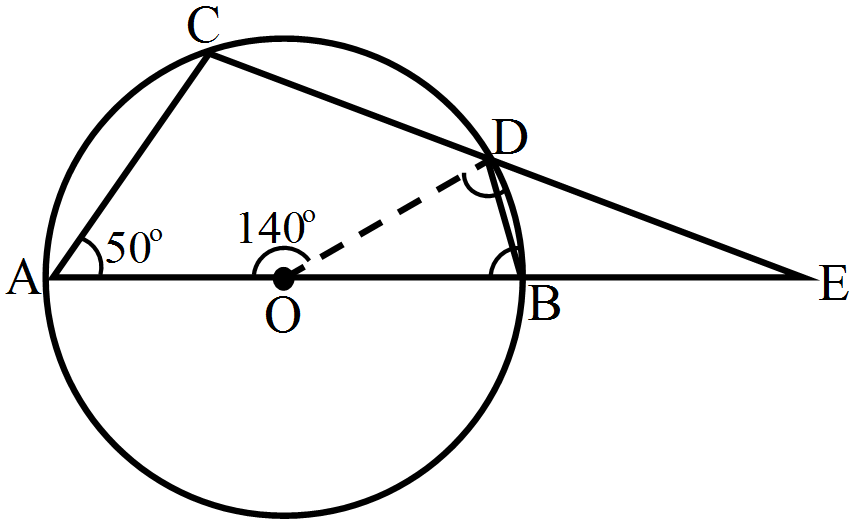
In the given figure, $O$ is the centre of a circle. If $\angle\text{AOC}=140^\circ$ and $\angle\text{CAB}=50^\circ,$ calculate
$i. \angle\text{EDB}$
$ii. \angle\text{EBD}$
If $3x = a + b + c$, then the value of $(x - a)^3 + (x - b)^3 + (x - c)^3 - 3(x - a) (x - b) (x - c)$ is:
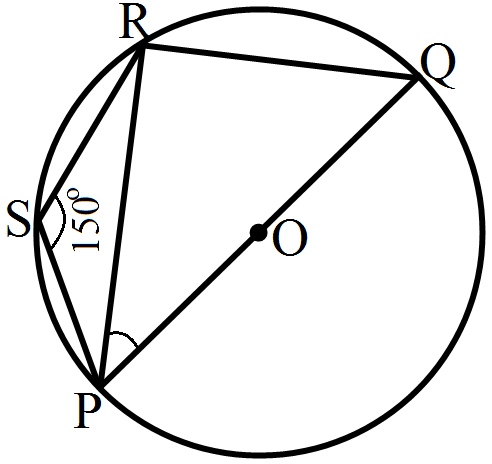
In the given figure, $POQ$ is a diameter and $PQRS$ is a cyclic quadrilateral. If $\angle\text{PSR}=150^\circ,$ find $\angle\text{RPQ}.$
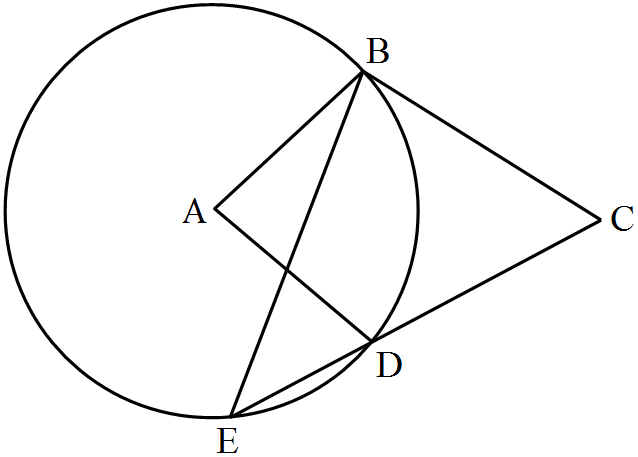
In the given figure, A is the centre of the circle. $ABCD$ is a parallelogram and $CDE$ is a straight line. Find $\angle\text{BCD}:\angle\text{ABE}.$