Question
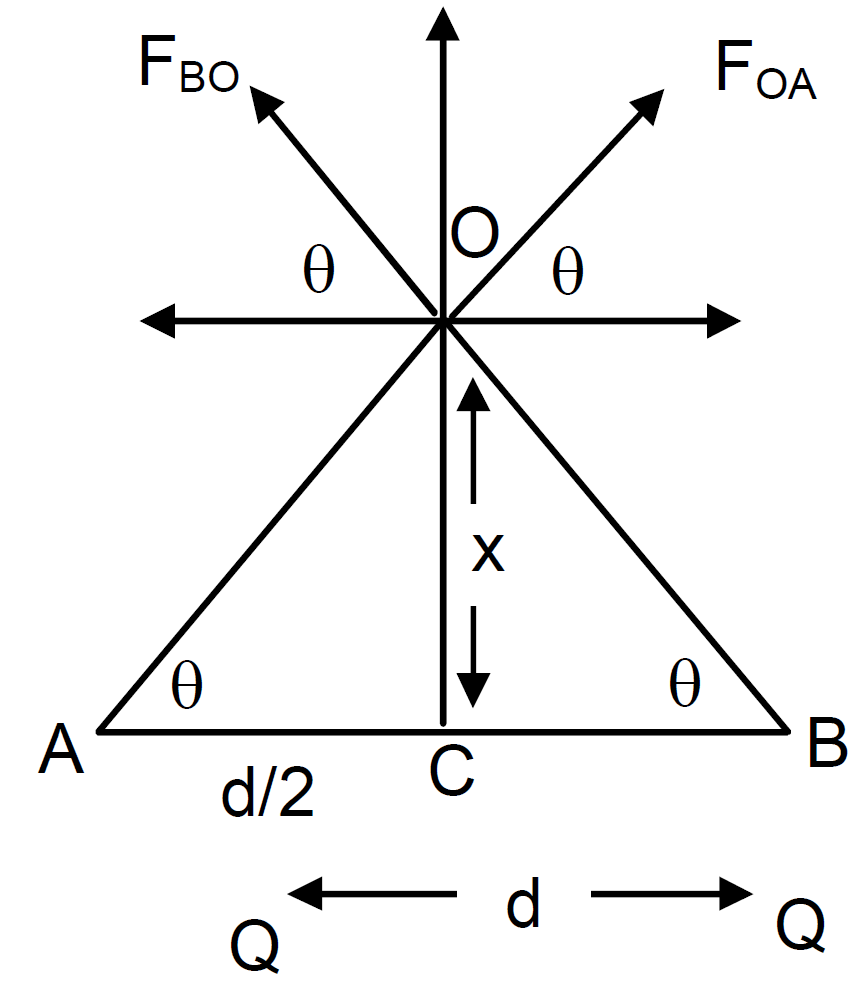
Two particles A and B, each carrying a charge Q, are held fixed with a separation d between them. A particle C having mass m and charge q is kept at the middle point of the line AB.
  1. If it is displaced through a distance x perpendicular to AB, what would be the electric force experienced by it.
  2. Assuming x << d, show that this force is proportional to x.
  3. Under what conditions will the particle C execute simple harmonic motion if it is released after such a small displacement?
Find the time period of the oscillations if these conditions are satisfied.

Answer


  1. Let Q = charge on A & B Separated by distance d

q = charge on c displaced $\bot$ to -AB

So, force on $0=\overline{\text{F}}_\text{AB}+\overline{\text{F}}_\text{BO}$

But $\text{F}_\text{AO}\cos\theta=\text{F}_\text{BO}\cos\theta$

So, force on ‘0’ in due to vertical component.

$\overline{\text{F}}=\text{F}_\text{AO}\sin\theta+\text{F}_\text{BO}\sin\theta$ $|\text{F}_\text{AO}|=|\text{F}_\text{BO}|$

$=2\frac{\text{KQq}}{\Big(\frac{\text{d}}{2^2+\text{x}^2}\big)}\sin\theta$

$\text{F}=\frac{2\text{KQq}}{\Big(\frac{\text{d}}{2}\Big)^2+\text{x}^2}\sin\theta$

$=\frac{4\times2\times2\text{KQq}}{(\text{d}^2+4\text{x}^2)}\times\frac{\text{x}}{\Big[\big(\frac{\text{d}}{2}\big)^2+\text{x}^2\Big]^{\frac{1}{2}}}$

$=\frac{2\text{kQq}}{\Big[\big(\frac{\text{d}}{2}\big)^2+\text{x}^2\Big]^{\frac{3}{2}}}\text{x}$ = Electric force $\Rightarrow\text{F}\propto\text{x}$

  1. When x << d

$\text{F}=\frac{2\text{kQq}}{\Big[\big(\frac{\text{d}}{2}\big)^2+\text{x}^2\Big]^{\frac{3}{2}}}\text{x}$ x << d

$\Rightarrow\text{F}=\frac{2\text{kQq}}{\Big(\frac{\text{d}^2}{4}\Big)^{\frac{3}{2}}}\text{x}\Rightarrow\text{F}\propto\text{x}$

$\text{a}=\frac{\text{F}}{\text{m}}=\frac{1}{\text{m}}\Bigg[\frac{2\text{kQqx}}{\Big[\big(\frac{\text{d}^2}{4}\big)+\ell^2}\Bigg]$

So time period $\text{T}=2\pi\sqrt{\frac{\ell}{\text{g}}}$

$=2\pi\sqrt{\frac{\ell}{\text{a}}}$

Need a full question paper?

Generate a complete, print-ready paper with questions like this in minutes — across 16+ boards, with answer keys.

Start Generating Free

Similar questions

In a Young's double slit experiment using monochromatic light, the fringe pattern shifts by a certain distance on the screen when a mica sheet of refractive index 1.6 and thickness 1.964 micron (1 micron = 10-6m) is introduced in the path of one of the interfering waves. The mica sheet is then removed and the distance between the screen and the slits is doubled. It is found that the distance between the successive maxima now is the same as the observed fringe-shift upon the introduction of the mica sheet. Calculate the wavelength of the monochromatic light used in the experiment.
A charge of 8 mC is located at the origin. Calculate the work done in taking a small charge of –2 × 10⁻⁹ C from a point P (0, 0, 3 cm) to a point Q (0, 4 cm, 0), via a point R (0, 6 cm, 9 cm).
A bar magnet of magnetic moment m and moment of inertia I (about centre, perpendicular to length) is cut into two equal pieces, perpendicular to length. Let T be the period of oscillations of the original magnet about an axis through the mid point, perpendicular to length, in a magnetic field B. What would be the similar period T' for each piece?
The door of an almirah is 6ft high, 1.5ft wide and weighs 8kg. The door is supported by two hinges situated at a distance of 1ft from the ends. If the magnitudes of the forces exerted by the hinges on the door are equal, find this magnitude.
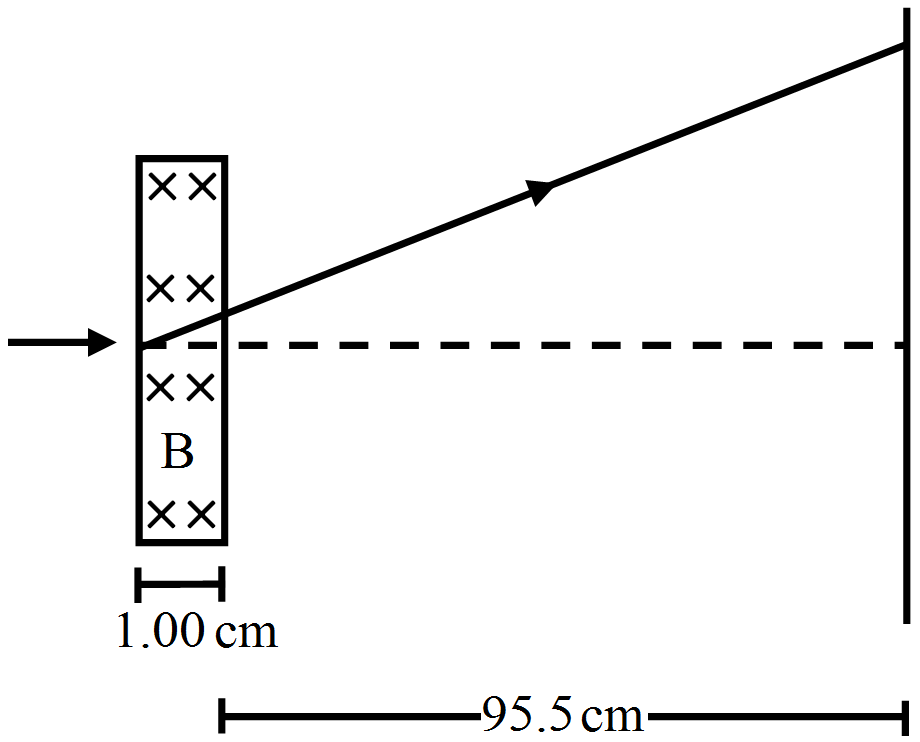
A narrow beam of singly charged potassium ions of kinetic energy 32keV is injected into a region of width 1.00cm with a magnetic field of strength 0.500T, as shown in the figure. The ions are collected at a screen 95.5cm away from the field region. If the beam contains isotopes of atomic weights 39 and 41, find the separation between the points where these isotopes strike the screen. Take the mass of a potassium ion = A (1.6 × 10⁻²⁷)kg, where A is the mass number.

A gun is mounted on a railroad car. The mass of the car, the gun, the shells and the operator is 50m where m is the mass of one shell. If the velocity of the shell with respect to the gun (in its state before firing) is 200m/s, what is the recoil speed of the car after the second shot? Neglect friction.
One end of a 10cm long silk thread is fixed to a large vertical surface of a charged nonconducting plate and the other end is fastened to a small ball having a mass of 10g and a charge of 4.0 × 10⁻⁵C. In equilibrium, the thread makes an angle of 60° with the vertical. Find the surface charge density on the plate.
Given the resistances of $1\ \Omega,\ 2\ \Omega,\ 3\ \Omega,$ how will be combine them to get an equivalent resistance of,
  1. $(11/3)\ \Omega$
  2. $(11/5)\ \Omega$
  3. $6\ \Omega$
  4. $(6/11)\ \Omega?$
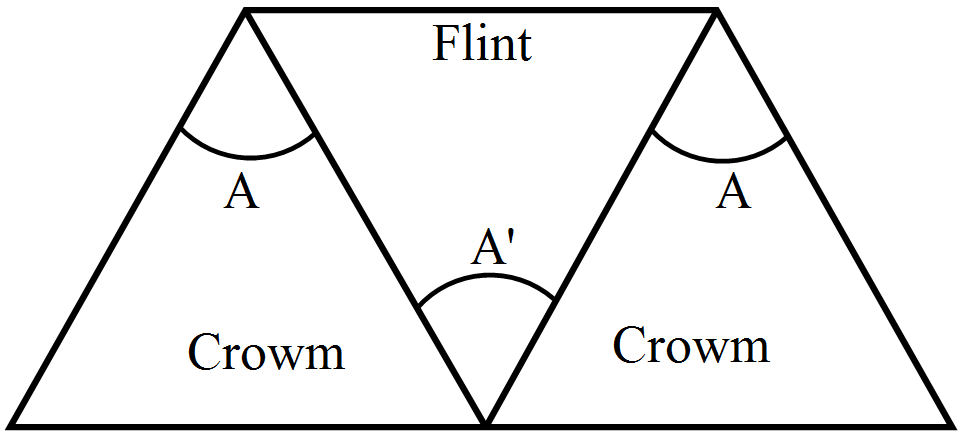
Three thin prisms are combined as shown in figure. The refractive indices of the crown glass for red, yellow and violet rays are $\mu_\text{r},\mu_\text{y}$ and $\mu_\text{v}$ respectively and those for the flint glass are $\mu'_\text{r},\mu'_\text{y}$ and $\mu'_\text{v}$ respectively. Find the ratio $\frac{\text{A}'}{\text{A}}$ for which.

  1. There is no net angular dispersion.
  2. There is no net deviation in the yellow ray.
Explain with the help of a circuit diagram how the value of unknown resistance can be determined using a Wheatstone Bridge. Give the formula used.