MCQ
Two particles $A$ and $B,$ move with constant  velocities $\vec v_1$ and $\vec v_2$. At the initial moment their position vectors are $\vec r_1$ and $\vec r_2$ respectively. The condition for particles $A$ and $B$ for their collision is
  • $\frac{{\overrightarrow {{r_1}} - \overrightarrow {{r_2}} }}{{\left| {\overrightarrow {{r_1}} - \overrightarrow {{r_2}} } \right|}} = \;\frac{{\overrightarrow {{v_2}} - \overrightarrow {{v_1}} }}{{\left| {\overrightarrow {{v_2}} - \overrightarrow {{v_1}} } \right|}}\;\;\;$
  • B
    $\overrightarrow {{r_1}} $ -$\overrightarrow {{r_2}} $ = $\overrightarrow {{v_1}} $ -$\overrightarrow {{v_2}} $
  • C
    $\;\overrightarrow {{r_1}} $ .$\;\overrightarrow {{v_1}} $ =$\overrightarrow {{r_2}} $ .$\;\overrightarrow {{v_2}} $
  • D
    $\;\overrightarrow {{r_1}} \times \overrightarrow {{v_1}}=\overrightarrow {{r_2}}  \times \overrightarrow {{v_2}} $
Answer

Correct option: A.
$\frac{{\overrightarrow {{r_1}} - \overrightarrow {{r_2}} }}{{\left| {\overrightarrow {{r_1}} - \overrightarrow {{r_2}} } \right|}} = \;\frac{{\overrightarrow {{v_2}} - \overrightarrow {{v_1}} }}{{\left| {\overrightarrow {{v_2}} - \overrightarrow {{v_1}} } \right|}}\;\;\;$
a
$\begin{array}{l}
\,\,\,\,\,\,\,\,\,\,\,\,\,\,\,\,Let\,the\,particles\,A\,and\,B\,collide\\
at\,time\,t.\,For\,their\,collision,\,the\,position\\
vectors\,of\,both\,particles\,sholud\,be\,\\
same\,at\,time\,t,\,i.e.,\\
{{\vec r}_1} + {{\vec v}_1}t = {{\vec r}_2} + {{\vec v}_2}t\,;\,{{\vec r}_1} - {{\vec r}_2} = {{\vec v}_2}t - {{\vec v}_1}t\\
 = \left( {{{\vec v}_2} - {{\vec v}_1}} \right)t\,\,\,\,\,\,\,\,\,\,\,\,\,\,\,\,\,\,\,\,\,\,\,\,\,\,\,\,\,\,\,\,\,\,\,\,\,\,\,\,\,\,\,\,\,\,...\left( i \right)
\end{array}$

$\begin{array}{l}
Also,\,\left| {\,{{\vec r}_1} - {{\vec r}_2}} \right| = \left| {{{\vec v}_2} - {{\vec v}_1}} \right|t\,\,or\,t = \frac{{\left| {\,{{\vec r}_1} - \vec r} \right|}}{{\left| {{{\vec v}_2} - {{\vec v}_1}} \right|}}\\
Substituting\,this\,value\,of\,t\,in\,eqn.\,\left( i \right),\\
we\,get\,\\
\,\,\,\,\,\,\,\,\,\,\,\,\,\,\,{{\vec r}_1} - {{\vec r}_2} = \left( {{{\vec v}_2} - {{\vec v}_1}} \right)\frac{{\left| {\,{{\vec r}_1} - \vec r} \right|}}{{\left| {{{\vec v}_2} - {{\vec v}_1}} \right|}}\\
or\,\frac{{\left| {\,{{\vec r}_1} - {{\vec r}_2}} \right|}}{{\left| {\,{{\vec r}_1} - {{\vec r}_2}} \right|}} = \frac{{\left( {{{\vec v}_2} - {{\vec v}_1}} \right)}}{{\left| {{{\vec v}_2} - {{\vec v}_1}} \right|}}
\end{array}$

Need a full question paper?

Generate a complete, print-ready paper with questions like this in minutes — across 16+ boards, with answer keys.

Start Generating Free

Similar questions

A small disk is attached to the end of a light inextensible string, which passes through a hole in a frictionless horizontal tabletop. Initially the disk moves on a circle of radius $R$ with kinetic energy $K_0$. The string is then slowly pulled so that the disk finally rotates on a circle of radius $\frac{R}{\eta }$. What is the work $W$ done in pulling the string
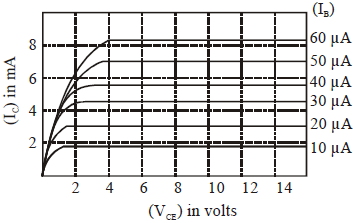
The output characteristics of a transistor is shown in the figure. When $V_{C E}$ is $10\, V$ and $I_{ C }=4.0\, mA ,$ then value of $\beta_{ ac }$ is
The quantities remaining constant in a collision are
A stone of mass $m$, tied to the end of a string , is whirled around in a circle on a horizontal frictionless table. The length of the string is reduced gradually keeping the angular momentum of the stone about the centre of the circle constant. Then , the tension in the string is given by $T\, = Ar^n$, where $A$ is a constant, $r$ is the instantaneous radius of the circle. The value of $n$ is equal to
The minimum intensity of sound is zero at a point due to two sources of nearly equal frequencies, when
A particle moves in the $X-Y$ plane under the influence of a force such that its linear momentum is $\overrightarrow{\mathrm{p}}(t)=A[\hat{\mathrm{i}} \cos (\mathrm{kt})-\hat{\mathrm{j}} \sin (\mathrm{kt})]$, where $A$ and $k$ are constants. The angle between the force and the momentum is
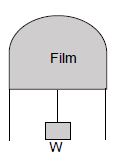
A thin liquid film formed between a $U-$ shaped wire and a light slider supports a weight of $1.5 \times 10^{-2}\ N$ (see figure). The length of the slider is $30\ cm$ and its weight are negligible. The surface tension of the liquid film is
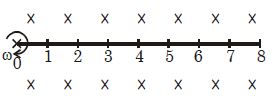
A rod of length $l$ is rotating with constant angular velocity $\omega $ and we marked the rod $0, 1, 2, .......... 8$ at equal spacing. Potential difference between consecutive points, if we go from left to right will be 
In Young's experiment, the distance between the slits is reduced to half and the distance between the slit and screen is doubled, then the fringe width
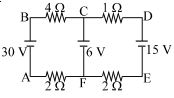
The figure shows a network of four resistances and three batteries The current through the branch $CF$ is ............... $A$