MCQ
Two particles $A$ and $B$, move with constant velocities ${\vec v_1}$ and ${\vec v_2}$. At the initial moment their position vectors are ${\vec r_1}$ and ${\vec r_2}$ respectively. The condition for their collision is
  • A
    ${\vec r_1} - {\vec r_2} = {\vec v_1} - {\vec v_2}$
  • $\frac{{{{\vec r}_1} - {{\vec r}_2}}}{{\left| {{{\vec r}_1} - {{\vec r}_2}} \right|}} = \frac{{{{\vec v}_2} - {{\vec v}_1}}}{{\left| {{{\vec v}_2} - {{\vec v}_1}} \right|}}$
  • C
    ${{\vec r}_1}.{{\vec v}_1} = {{\vec r}_2}.{{\vec v}_2}$
  • D
    ${{\vec r}_1} \times {{\vec v}_1} = {{\vec r}_2} \times {{\vec v}_2}$
Answer

Correct option: B.
$\frac{{{{\vec r}_1} - {{\vec r}_2}}}{{\left| {{{\vec r}_1} - {{\vec r}_2}} \right|}} = \frac{{{{\vec v}_2} - {{\vec v}_1}}}{{\left| {{{\vec v}_2} - {{\vec v}_1}} \right|}}$
b
For two particles to collide, the direction of the relative velocity of one with respect to other should be directed towands the relative position of the other particle

ie. $\frac{\vec{\mathrm{r}}_{1}-\vec{\mathrm{r}}_{2}}{\left|\vec{\mathrm{r}}_{1}-\vec{\mathrm{r}}_{2}\right|} \rightarrow$ clivection of relative position of $1 \mathrm{w.r.t}$ $2$

 $\frac{\vec{\mathrm{v}}_{2}-\vec{\mathrm{v}}_{1}}{\left|\vec{\mathrm{v}}_{2}-\vec{\mathrm{v}}_{1}\right|} \rightarrow$ direction of velocity of $2 \mathrm{w}$ $r.t. 1$

so for collision of $\mathrm{A} \& \mathrm{B}$

$\frac{\overrightarrow{\mathrm{r}}_{1}-\overrightarrow{\mathrm{r}}_{2}}{\left|\overrightarrow{\mathrm{r}}_{1}-\overrightarrow{\mathrm{r}}_{2}\right|}=\frac{\overrightarrow{\mathrm{v}}_{2}-\overrightarrow{\mathrm{v}}_{1}}{\left|\overrightarrow{\mathrm{v}}_{2}-\overrightarrow{\mathrm{v}}_{1}\right|}$

Need a full question paper?

Generate a complete, print-ready paper with questions like this in minutes — across 16+ boards, with answer keys.

Start Generating Free

Similar questions

A ball falls vertically downward and bounces off a horizontal floor.The speed of the ball just before reaching the floor $\left(u_1\right)$ is equal to the speed just after leaving contact with the floor $\left(u_2\right), u_1=u_2$. The corresponding magnitudes of accelerations are denoted respectively by $a_1$ and $a_2$. The air resistance during motion is proportional to speed and is not negligible. If $g$ is acceleration due to gravity, then
If $A = 3\hat i + 4\hat j$ and $B = 7\hat i + 24\hat j,$the vector having the same magnitude as $B$ and parallel to $A$ is
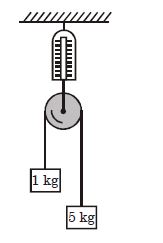
Two blocks of masses of $1\,kg$ and $5\,kg$ are attached to the ends of a massless string passing over a pulley of negligible weight. The pulley itself is attached to a spring balance as shown in figure. The blocks start moving, during this interval; the reading of spring balance will be
Two gases have the same initial pressure, volume and temperatue. They expand to the same final volume, one adiabatically and the other isothermally
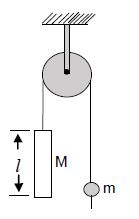
Figure shows an arrangement of a rod of length $l$ and mass $M$ and a bead of mass $m$ attached to a weightless string passing over a frictionless pulley. At $t = 0$ , the bead is in level with the lower end of the rod. The bead slides down the string with considerable friction and is opposite to the other end of the rod after $T\ second$ . Assuming friction between the beadand the string to be constant all through, the frictional force is
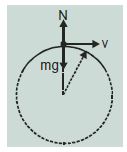
A circular overbridge has radius $20\,m$. What is the maximum speed with which a car can cross the bridge without leaving contact with the overbridge at the heighest point ? $ (g = 9.8\, m/s^2)$ 

............ $m/s$

A particle $(A)$ moves due north at $3\,km / h$ another particle $(B)$ due west at $4\,km / h$. The relative velocity of $A$ with respect to $B$ is $\left(\tan 37^{\circ}=3 / 4\right)$
The time period of a simple pendulum on a freely moving artificial satellite is
The velocity of a body moving with a uniform acceleration of $2\,\,m/{\sec ^2}$ is $10\,\,m/\sec $. Its velocity after an interval of $4 \,sec$ is...........$m/\sec $
When a large bubble rises from the bottom of a lake to the surface, its radius doubles. One atmosphere is equal to that of a column of water of height H. The depth of the lake is: