Question
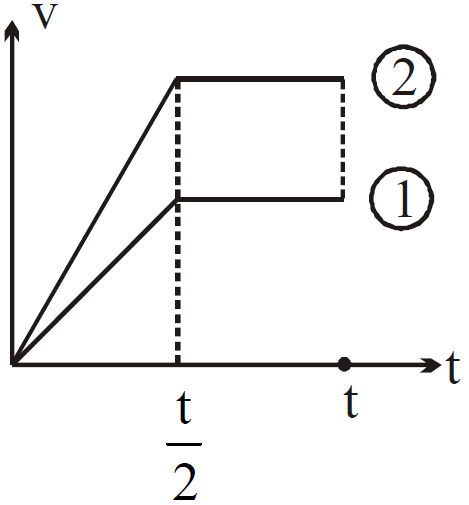
Two particles A and B start from rest and move for equal time on a straight line. The particle A has an acceleration a for the first half of the total time and 2a for the second half. The particle B has an acceleration 2a for the first half and a for the second half. Which particle has covered larger distance?
Answer

Second particle

Area under (v, t) graph gives displacement. For graph (2) area is more.

Need a full question paper?

Generate a complete, print-ready paper with questions like this in minutes — across 16+ boards, with answer keys.

Start Generating Free

Similar questions

In which activities does the law of conservation of charge apply?
Einstein's photoelectric equation is based on which conservation law?
When a glass lens with refractive index 1.45 is immersed in a liquid, it is not visible. What will be the refractive index of the liquid?
A Kundt's tube apparatus has a copper rod of length 1.0m clamped at 25cm from one of the ends. The tube contains air in which the speed of sound is 340m/s. The powder collects in heaps separated by a distance of 5.0cm. Find the speed of sound waves in copper.
Find the thickness of a plate which will produce a change in optical path equal to half the wavelength $\lambda$ of the light passing through it normally. The refractive index of the plate is $\mu$.
Which types of fields are produced by a moving electron? If electron is at rest, then what type of field is produced?
The wavelength of electromagnetic radiation is doubled; how will the energy of a photon change?
A cube of iron (density $=8000 \mathrm{~kg} \mathrm{~m}^{-3}$, specific heat capacity $=470 \mathrm{~J} \mathrm{~kg}^{-1} \mathrm{~K}^{-1}$ ) is heated to a high temperature and is placed on a large block of ice at $0^{\circ} \mathrm{C}$. The cube melts the ice below it, displaces the water and sinks. In the final equilibrium position, its upper surface just goes inside the ice. Calculate the initial temperature of the cube. Neglect any loss of heat outside the ice and the cube. The density of ice $=900 \mathrm{~kg} \mathrm{~m}^{-3}$ and the latent heat of fusion of ice $=3.36 \times 10^5 \mathrm{~J} \mathrm{~kg}^{-1}$.
Which waves are used in telecommuni-cation? Write their range.
What is the average value of alternating current in one complete cycle?