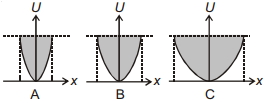
Two particles are executing $SHM$ in a straight line. Amplitude $'A'$ and time period $'T'$ of both the particles are equal. At time $t = 0$ one particle is at displacement $x_1 = +A$ and other at ${x_2} = \frac{{ - A}}{2}$ and they are approaching towards each other. Time after which they will cross each other is
Advanced
Download our app for free and get started
time when they will cross each other $=\mathrm{T} / 12+\mathrm{T} / 12$
$=\mathrm{T} / 6$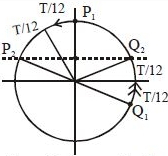

Download our appand get started for free
Experience the future of education. Simply download our apps or reach out to us for more information. Let's shape the future of learning together!No signup needed.*
Similar Questions
- 1The displacement of a particle moving in $S.H.M.$ at any instant is given by $y = a\sin \omega t$. The acceleration after time $t = \frac{T}{4}$ is (where $T$ is the time period)View Solution
- 2A body is executing simple harmonic motion of amplitude $a$ and period $T$ about the equilibrium position $x=0$. Large numbers of snapshots are taken at random of this body in motion. The probability of the body being found in a very small interval $x$ to $x+|d x|$ is highest atView Solution
- 3View SolutionIdentify the function which represents a nonperiodic motion.
- 4A mass m is suspended from a spring of length l and force constant $K$. The frequency of vibration of the mass is ${f_1}$. The spring is cut into two equal parts and the same mass is suspended from one of the parts. The new frequency of vibration of mass is ${f_2}$. Which of the following relations between the frequencies is correctView Solution
- 5A particle of mass $2 \,kg$, executing $SHM$ has amplitude $20 \,cm$ and time period $1 \,s$. Its maximum speed is ......... $m / s$View Solution
- 6The function of time representing a simple harmonic motion with a period of $\frac{\pi}{\omega}$ is :View Solution
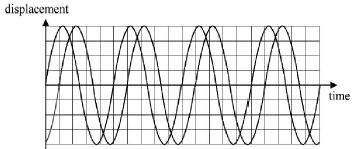
- 7View SolutionThe diagram shows two oscillations. What is the phase difference between the oscillations?
- 8Two particles are executing simple harmonic motion of the same amplitude $A$ and frequency $\omega $ along the $x-$ axis. Their mean position is separated by distance $X_0 (X_0> A)$. If the maximum separation between them is $(X_0 +A)$, the phase difference between their motion isView Solution
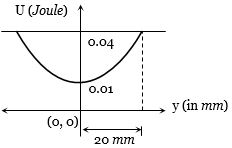
- 9View SolutionThe variation of potential energy of harmonic oscillator is as shown in figure. The spring constant is
- 10The variations of potential energy $(U)$ with position $x$ for three simple harmonic oscillators $A, B$ and $C$ are shown in figure. The oscillators have same mass. The time period of oscillation is greatest forView Solution