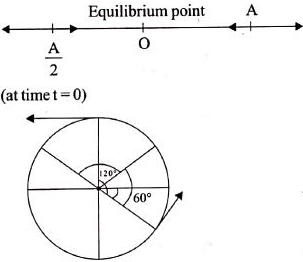
Two particles are performing simple harmonic motion in a straight line about the same equilibrium point. The amplitude and time period for both particles are same and equal to $A$ and $T,$ respectively. At time $t=0$ one particle has displacement $A$ while the other one has displacement $\frac {-A}{2}$ and they are moving towards each other. If they cross each other at time $t,$ then $t$ is
JEE MAIN 2016, Diffcult
Download our app for free and get started
Angle covered to meet $\theta=60^{\circ}=\frac{\pi}{3} \mathrm{rad}$
Experience the future of education. Simply download our apps or reach out to us for more information. Let's shape the future of learning together!No signup needed.*
A particle moves in the $x-y$ plane according to equation $\overrightarrow r = (\widehat i + 2\widehat j)\, A \, \cos \omega t$. The motion of the particle is
A man weighing $60\ kg$ stands on the horizontal platform of a spring balance. The platform starts executing simple harmonic motion of amplitude $0.1\ m$ and frequency $\frac{2}{\pi } Hz$. Which of the following staements is correct
A particle starts with $S.H.M.$ from the mean position as shown in the figure. Its amplitude is $A$ and its time period is $T$. At one time, its speed is half that of the maximum speed. What is this displacement?
A spring whose unstretched length is $\ell $ has a force constant $k$. The spring is cut into two pieces of unstretched lengths $\ell_1$ and $\ell_2$ where, $\ell_1 = n\ell_2$ and $n$ is an integer. The ratio $k_1/k_2$ of the corresponding force constants, $k_1$ and $k_2$ will be
A ring is hung on a nail. It can oscillate, without slipping or sliding $(i)$ in its plane with a time period $T_{1}$ and, $(ii)$ back and forth in a direction perpendicular to its plane, with a period $T _{2}$. the ratio $\frac{ T _{1}}{ T _{2}}$ will be
The time period of oscillations of a simple pendulum is $1$ minute. If its length is increased by $44 \%$. then its new time period of oscillation will be ......... $s$
A mass $0.9\,kg$, attached to a horizontal spring, executes $SHM$ with an amplitude $A _{1}$. When this mass passes through its mean position, then a smaller mass of $124\,g$ is placed over it and both masses move together with amplitude $A _{2}$. If the ratio $\frac{ A _{1}}{ A _{2}}$ is $\frac{\alpha}{\alpha-1}$, then the value of $\alpha$ will be$......$
The time period of a seconds pendulum is $2\, sec$. The spherical bob which is empty from inside has a mass $50\; gram$, this now is replaced by another solid of same radius but have different mass of $100\; gram$. The new time period will be ..... $\sec$