Question
Two particles, each with mass m are placed at a separation d in a uniform magnetic field B, as shown in the figure. They have opposite charges of equal magnitude q. At time t = 0, the particles are projected towards each other, each with a speed v. Suppose the Coulomb force between the charges is switched off.
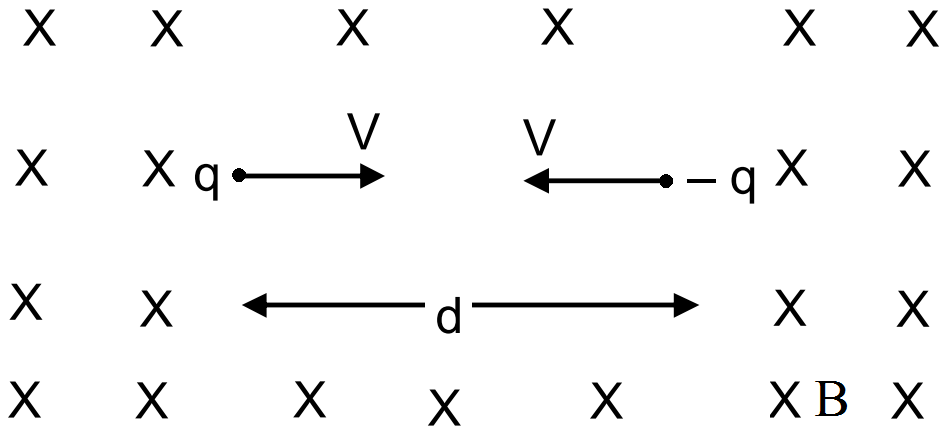
  1. Find the maximum value $v_m$ of the projection speed, so that the two particles do not collide.
  2. What would be the minimum and maximum separation between the particles if $\text{v}=\text{v}_{\text{m}}\sqrt{2}?$
  3. At what instant will a collision occur between the particles if $v = 2v_m?$
  4. Suppose $v = 2v_m$ and the collision between the particles is completely inelastic. Describe the motion after the collision.

Answer

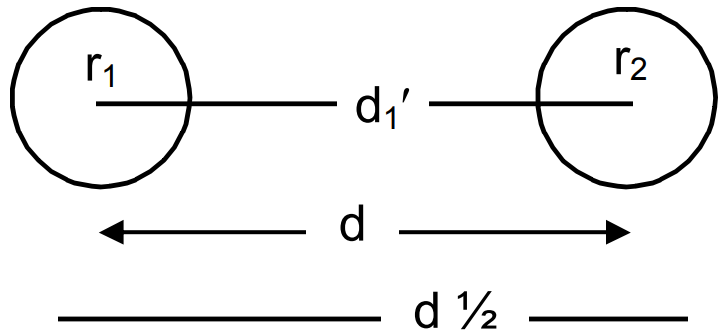
  1. The particulars will not collide if,
$\text{d}=\text{r}_1+\text{r}_2$

$\Rightarrow\text{d}=\frac{\text{mV}_\text{m}}{\text{qB}}+\frac{\text{mV}_\text{m}}{\text{qB}}$
$\Rightarrow\text{d}=\frac{2\text{mV}_\text{m}}{\text{qB}}$
$\text{V}_\text{m}=\frac{\text{qBd}}{2\text{m}}$
  1. $\text{V}=\frac{\text{V}_\text{m}}{2}$

$\text{d}_1'=\text{r}_1+\text{r}_2=\Big(\frac{\text{m}\times\text{qBd}}{2\times2\text{m}\times\text{qB}}\Big)=\frac{\text{d}}{2}$ (min. dist.)
Max. distance $\text{d}_2'=\text{d}+2\text{r}=\text{d}+\frac{\text{d}}{2}=\frac{3\text{d}}{2}$
  1. $\text{V}=2\text{V}_\text{m}$
$\text{r}_1'=\frac{\text{m}_2\text{V} _\text{m}}{\text{qB}}=\frac{\text{m}\times2\times\text{qBd}}{2\text{n}\times\text{qB}}$
$\text{r}_2=\text{d}$
$\therefore$ The arc is $\frac{1}{6}$
  1. $\text{V}_\text{m}=\frac{\text{qBd}}{2\text{m}}$

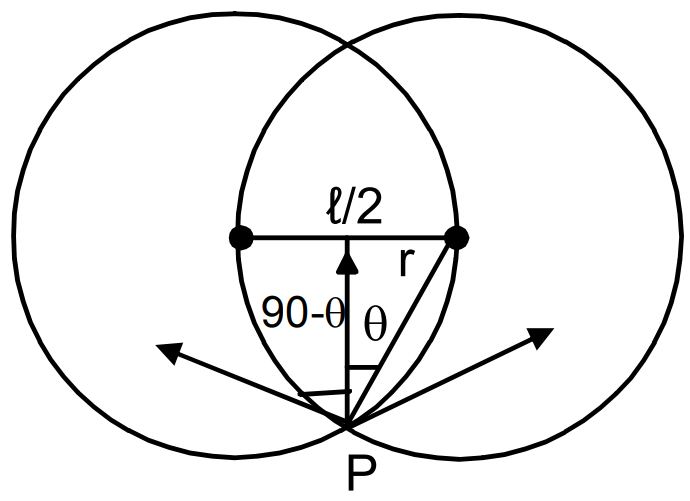
The particles will collide at point P. At point p, both the particles will have motion m in upward direction. Since the particles collide inelastically the stick together.
Distance l between centres $=\text{d},\sin\theta=\frac{1}{2\text{r}}$
Velocity upward $=\text{v}\cos90-\theta=\text{V}\sin\theta=\frac{\text{Vl}}{2\text{r}}$
$\frac{\text{mv}^2}{\text{r}}=\text{qvB}$
$\Rightarrow\text{r}=\frac{\text{mv}}{\text{qB}}$
$\text{V}\sin\theta=\frac{\text{vl}}{2\text{r}}=\frac{\text{vl}}{2\frac{\text{mv}}{\text{qb}}}=\frac{\text{qBd}}{2\text{m}}=\text{V}_\text{m}$
Hence the combined mass will move with velocity $V_m$.

Need a full question paper?

Generate a complete, print-ready paper with questions like this in minutes — across 16+ boards, with answer keys.

Start Generating Free

Similar questions

A charge Q is placed at the centre of an uncharged, hollow metallic sphere of radius a:
  1. Find the surface charge density on the inner surface and on the outer surface.
  2. If a charge q is put on the sphere, what would be the surface charge densities on the inner and the outer surfaces?
  3. Find the electric field inside the sphere at a distance x from the centre in the situations (a) and (b).
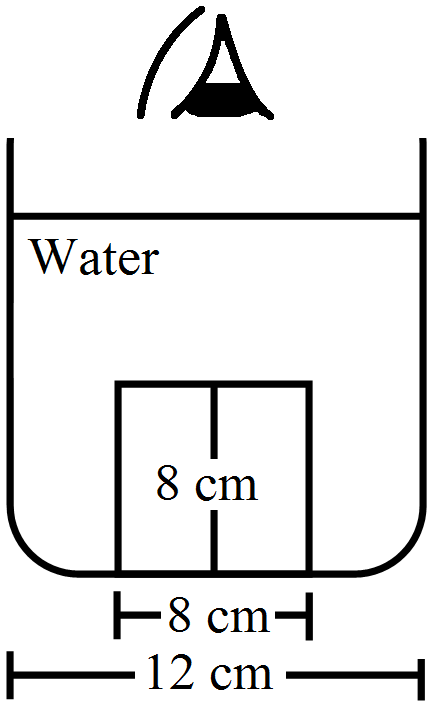
A cylindrical vessel of diameter 12cm contains $800\pi\text{cm}^3$ of water. A cylindrical glass piece of diameter 8.0 cm and height 8.0cm is placed in the vessel. If the bottom of the vessel under the glass piece is seen by the paraxial rays, locate its image. The index of refraction of glass is 1.50 and that of water is 1.33.
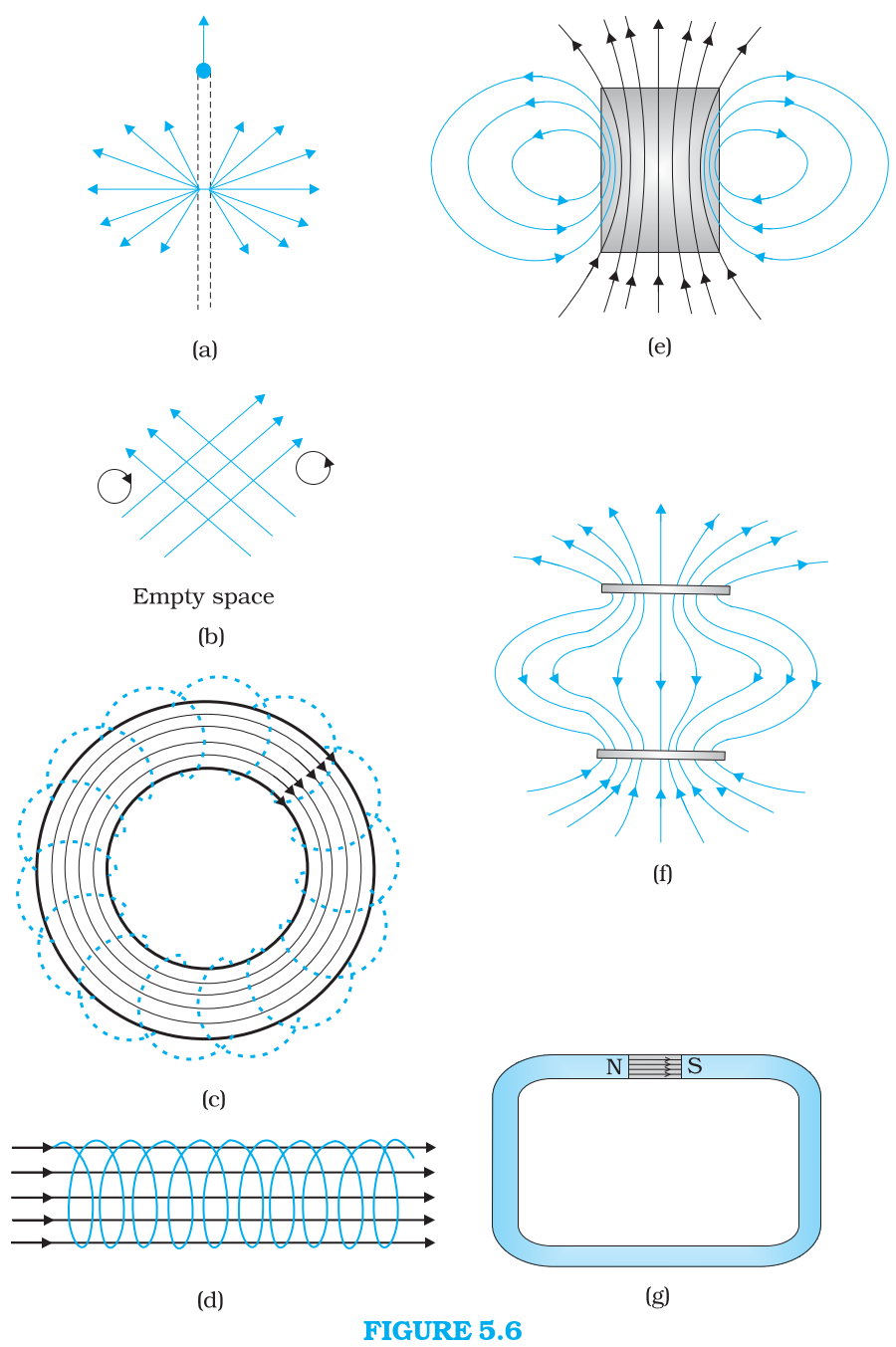
Many of the diagrams given in Fig. 5.7 show magnetic field lines (thick lines in the figure) wrongly. Point out what is wrong with them. Some of them may describe electrostatic field lines correctly. Point out which ones.
Image
Define induction coefficient. Explain the phenomenon of mutual inductance with the help of an experiment. Obtain an expression for mutual inductance coefficient of two solenoids and prove that $M=\sqrt{L_1 L_2}$.
One end of a 10cm long silk thread is fixed to a large vertical surface of a charged nonconducting plate and the other end is fastened to a small ball having a mass of 10g and a charge of $4.0 \times 10^{-5}C$. In equilibrium, the thread makes an angle of 60° with the vertical. Find the surface charge density on the plate.
Establish an expression for induced electromotive force due to rotational motion of a conducting rod in a uniform magnetic field.
Show that the first few frequencies of light that is emitted when electrons fall to the $n^{th}$ level from levels higher than n, are approximate harmonics (i.e. in the ratio 1 : 2: 3...) when n > > 1.
Explain the variation of conductivity with temperature for:
  1. A metallic conductor.
  2. Ionic conductors.
  3. Semiconductors.
Four particles having masses m, 2m, 3m and 4m are placed at the four corners of a square of edge a. Find the gravitational force acting on a particle of mass m placed at the centre.
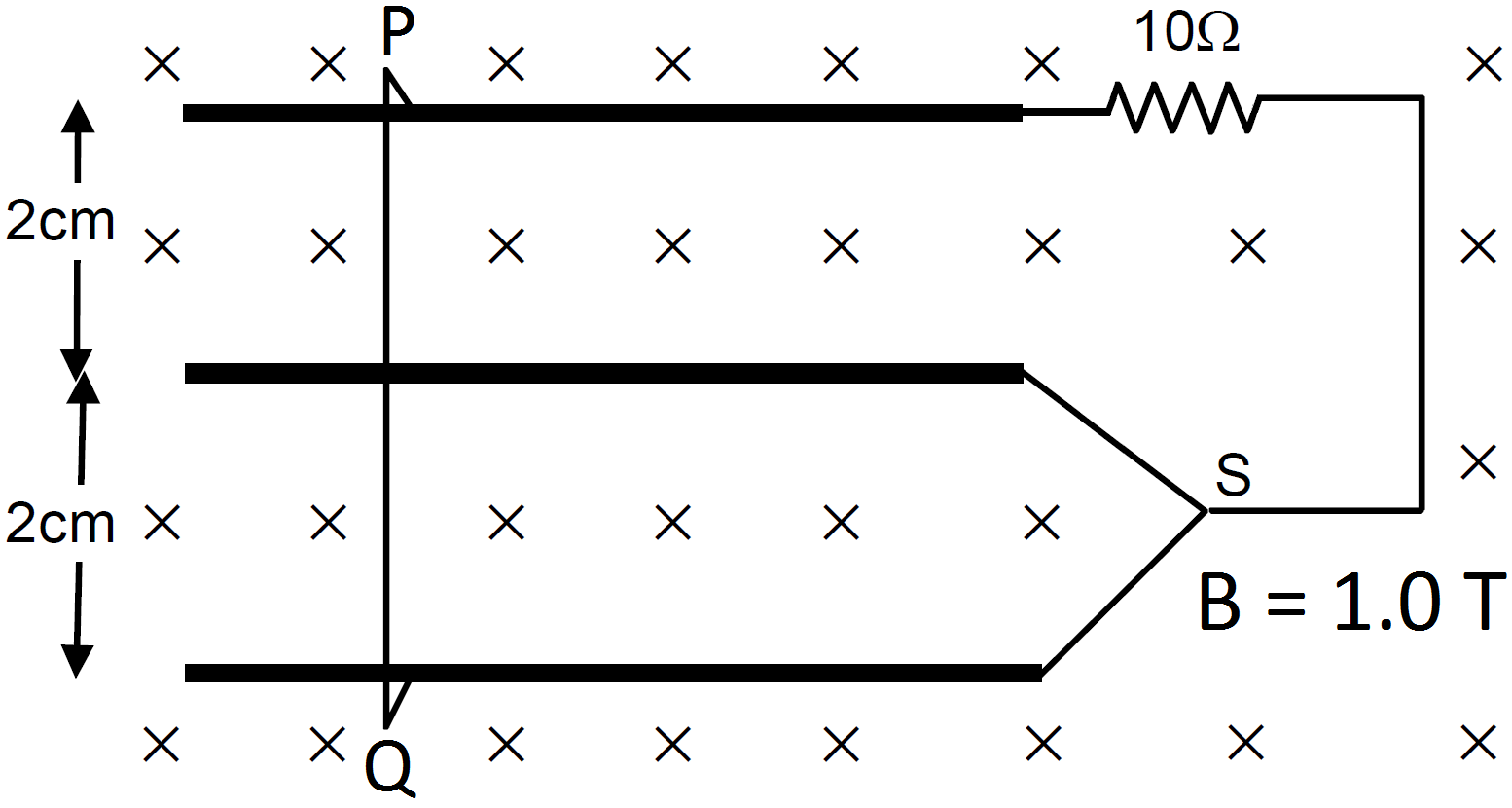
Consider the situation shown in figure. The wire PQ has a negligible resistance and is made to slide on the three rails with a constant speed of 5cm/s. Find the current in the $10\Omega$ resistor when the switch S is thrown to:
  1. The middle rail.
  2. The bottom rail.