MCQ
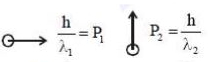
Two particles move at right angle to each other. Their de Broglie wavelengths are ${\lambda _1}$ and ${\lambda _2}$ respectively. The particles suffere perfectly inelastic collision. The de Broglie wavelength $\lambda $ , of the final particle, is given by
  • A
    $\lambda  = \sqrt {{\lambda _1}{\lambda _2}} $
  • B
    $\lambda  = \frac{{{\lambda _1} + {\lambda _2}}}{2}$
  • C
    $\frac{2}{\lambda } = \frac{1}{{{\lambda _1}}} + \frac{1}{{{\lambda _2}}}$
  • $\frac{1}{{{\lambda ^2}}} = \frac{1}{{\lambda _1^2}} + \frac{1}{{\lambda _2^2}}$
Answer

Correct option: D.
$\frac{1}{{{\lambda ^2}}} = \frac{1}{{\lambda _1^2}} + \frac{1}{{\lambda _2^2}}$
d
$\vec{P}_{1}=\frac{h}{\lambda_{1}} \hat{i}$ and $\vec{P}_{2}=\frac{h}{\lambda_{2}} \hat{j}$

Using momentum conservation

$\vec{P}=\vec{P}_{1}+\vec{P}_{2}=\frac{h}{\lambda_{1}} \hat{i}+\frac{h}{\lambda_{2}} \hat{j}$

$|\vec P| = \sqrt {{{\left( {\frac{h}{{{\lambda _1}}}} \right)}^2} + {{\left( {\frac{h}{{{\lambda _2}}}} \right)}^2}} $

$\frac{h}{\lambda}=\sqrt{\left(\frac{h}{\lambda_{1}}\right)^{2}+\left(\frac{h}{\lambda_{2}}\right)^{2}}$

$\frac{1}{\lambda^{2}}=\frac{1}{\lambda_{1}^{2}}+\frac{1}{\lambda_{2}^{2}}$

Need a full question paper?

Generate a complete, print-ready paper with questions like this in minutes — across 16+ boards, with answer keys.

Start Generating Free

Similar questions

Consider telecommunication through optical fibres. Which of the following statements is not true
The cut-in voltage for silicon diode is approximately.....$V$
In a single slit diffraction pattern, a light of wavelength $6000 \mathring A$ is used. The distance between the first and third minima in the diffraction pattern is found to be $3 \mathrm{~mm}$ when the screen in placed 50 $\mathrm{cm}$ away from slits. The width of the slit is ______________$\times 10^{-4} \mathrm{~m}$
Assertion : If the temperature of a semiconductor is increased then it’s resistance decreases.
Reason : The energy gap between conduction band and valence band is very small
Intensity of sunlight is observed as $0.092\, {Wm}^{-2}$ at a point in free space. What will be the peak value of magnetic field at that point? $\left(\sigma_{0}=8.85 \times 10^{-12}\, {C}^{2} \,{N}^{-1} \,{m}^{-2}\right.$ )
If in Bohr's atomic model, it is assumed that force between electron and proton varies inversely as $r^4$, energy of the system will be proportional to
If in a series $L-C$ - $R$ ac circuit, the voltages across $L, C$ and $R$ are $V_1, V_2$ and $V_3$ respectively, then the voltage of the source is always.
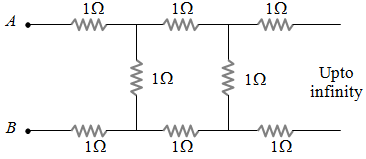
The resistance between the terminal points A and B of the given infinitely long circuit will be

The minimum frequency $\nu $ of continuous $X-$ rays is related to the applied potential difference $V$ as
The resistance of a galvanometer is 90 ohms. If only 10 percent of the main current may flow through the galvanometer, in which way and of what value, a resistor is to be used