MCQ
Two particles $P$ and $Q$ simultaneously start moving from point $A$ with velocities $15\,m / s$ and $20\,m / s$ respectively. The two particles move with accelerations equal in magnitude but opposite in direction. When $P$ overtakes $Q$ at $B$, then its velocity is $30\,m / s$. The velocity of $Q$ at point $B$ will be $..........\,m/s$
  • A
    $30$
  • $5$
  • C
    $20$
  • D
    $15$

Answer

Correct option: B.
$5$
b
(b)

For $P, 30=15+a t$

or $\quad a t=15\,m / s$

For $Q, v=20- at$

$v=20-15=5\,m / s$

Need a full question paper?

Generate a complete, print-ready paper with questions like this in minutes — across 16+ boards, with answer keys.

Start Generating Free

Similar questions

Two constant forces ${F_1} = 2\hat i - 3\hat j + 3\hat k\,$($N$) and ${F_2} = \hat i + \hat j - 2\hat k\,$($N$) act on a body and displace it from the position ${r_1} = \hat i + 2\hat j - 2\hat k\,$($m$) to the position ${r_2} = 7\hat i + 10\hat j + 5\hat k\,$($m$). What is the work done......... $J$
A body $A$ of mass $\mathrm{m}$ is moving in a circular orbit of radius $\mathrm{R}$ about a planet. Another body $\mathrm{B}$ of mass $\frac{\mathrm{m}}{2}$ collides with $\mathrm{A}$ with a velocity which is half $\left(\frac{\overrightarrow{\mathrm{v}}}{2}\right)$ the instantaneous velocity $\overrightarrow{\mathrm{v}}$ of $\mathrm{A}$ The collision is completely inelastic. Then, the combined body
Which of the following statements is correct about satellites?
When a pressure of 100 atmosphere is applied on a spherical ball of rubber, then its volume reduces to 0.01%. The bulk modulus of the material of the rubber in dyne cm-2 is:
A body of mass $2\, kg$ is being dragged with uniform velocity of $2\, m/s$ on a rough horizontal plane. The coefficient of friction between the body and the surface is $0.20$. The amount of heat generated in $5 sec$ is ........ $cal$ $(J = 4.2\,joule/cal$ and $g = 9.8\,m/{s^2})$
How does the displacement v/s time graph of a uniformly accelerated motion look like?
Two masses $M$ and $m$ are attached to a vertical axis by weightless threads of combined length $l$. They are set in rotational motion in a horizontal plane about this axis with constant angular velocity $\omega $. If the tensions in the threads are the same during motion, the distance of $M$ from the axis is
Every planet revolves around the sun in an elliptical orbit :

$A.$ The force acting on a planet is inversely proportional to square of distance from sun.

$B.$ Force acting on planet is inversely proportional to product of the masses of the planet and the sun

$C.$ The centripetal force acting on the planet is directed away from the sun.

$D.$ The square of time period of revolution of planet around sun is directly proportional to cube of semi-major axis of elliptical orbit.

Choose the correct answer from the options given below :

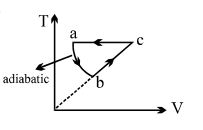
$PV$ curve for the process whose $VT$ curve is
A particle returns to the starting point after $10\,s$. If the rate of change of velocity during the motion is constant, then its location after $7\,s$ will be same as that after $...........\,s$