MCQ
Two particles $X$ and $Y$ having equal charge, after being accelerated through the same potential difference enter a region of uniform magnetic field and describe circular paths of radii $R_1$ and $R_2$ respectively. The ratio of the mass of $X$ to that of $Y$ is:
  • A
    $\Big(\frac{\text{R}_1}{\text{R}_2}\Big)^{\frac{1}{2}}$
  • B
    $\frac{\text{R}_1}{\text{R}_2}$
  • $\Big(\frac{\text{R}_1}{\text{R}_2}\Big)^2$
  • D
    $\text{R}_1\text{R}_2.$

Answer

Correct option: C.
$\Big(\frac{\text{R}_1}{\text{R}_2}\Big)^2$
Particles $X$ and $Y$ of respective masses $m_1$ and $m_2$ are carrying charge $q$ describing circular paths with respective radii $R_1$ and $R_2$ such that,
$\text{R}_1=\frac{\text{m}_1\text{v}_1}{\text{qB}}$
$\text{R}_1=\frac{\text{m}_2\text{v}_2}{\text{qB}}$
Since both the particles are accelerated through the same potential difference, both will have the same kinetic energy.
$\therefore\frac{1}{2}\text{m}_1\text{v}_1^2=\frac{1}{2}\text{m}_2\text{v}_2^2$
$\because\text{R}_1=\frac{\text{m}_1\text{v}_1}{\text{qB}}\Rightarrow\text{v}_1=\frac{\text{R}_1\text{qB}}{\text{m}_1}$
And,
$\text{R}_2=\frac{\text{m}_2\text{v}_2}{\text{qB}}\Rightarrow\text{v}_2=\frac{\text{R}_2\text{qB}}{\text{m}_2}$
$\therefore\text{m}_1\Big(\frac{\text{R}_1\text{qB}}{\text{m}_1}\Big)^2=\text{m}_2\Big(\frac{\text{R}_2\text{qB}}{\text{m}_2}\Big)^2$
$\Rightarrow\frac{\text{m}_1}{\text{m}_2}=\frac{\text{R}_1^2}{\text{R}_2^2}=\Big(\frac{\text{R}_1}{\text{R}_2}\Big)^2$

Need a full question paper?

Generate a complete, print-ready paper with questions like this in minutes — across 16+ boards, with answer keys.

Start Generating Free

Similar questions

A ray of light incident at an angle \theta on a refracting face of a prism emerges from the other face normally. If the angle of the prism is $5^\circ$ and the prism is made of a material of refractive index $1.5,$ the angle of incidence is :
A tuning fork of frequency 480Hz is used to vibrate a sonometer wire having natural frequency 240Hz. The wire will vibrate with a frequency of:
  1. 240Hz
  2. 480Hz
  3. 720Hz
  4. Will not vibrate.
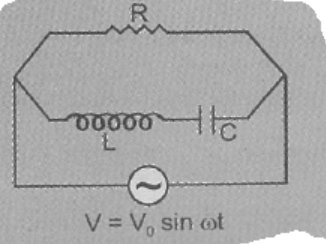
The Current in resistance $R$ at resonance is.
Image
Curies law can be written as
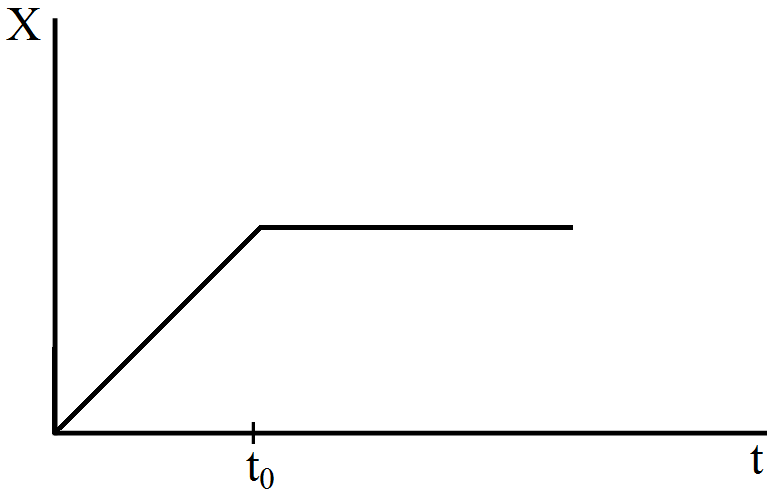
Figure shows the displacement-time graph of a particle moving on the $X-$axis.
  1. The particle is continuously going in positive $x$ direction.
  2. The particle is at rest.
  3. The velocity increases up to a time to, and then becomes constant.
  4. The particle moves at a constant velocity up to a time to, and then stops.
The magnetic force required to demagnetise the material is:
An electric line of force in the xy plane is given by equation $x^2 + y^2 = 1$. A particle with unit positive charge, initially at rest at the point $x = 1, y = 0$  in the $xy$ plane
An electric dipole consisting of two opposite charges of $2 \times 10^{-6} C$ each separated by a distance of $3 \ cm$ is placed in an electric field of $2 \times 10^5\ N / C$. The maximum torque on the dipole will be
What causes chromatic aberration?
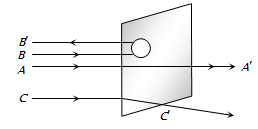
A beam of fast moving alpha particles were directed towards a thin film of gold. The parts $A^{\prime}, B^{\prime}$ and $C^{\prime}$ of the transmitted and reflected beams corresponding to the incident parts $A, B$ and $C$ of the beam, are shown in the adjoining diagram. The number of alpha particles in