- $\Big(\frac{\text{R}_1}{\text{R}_2}\Big)^{\frac{1}{2}}$
- $\frac{\text{R}_1}{\text{R}_2}$
- $\Big(\frac{\text{R}_1}{\text{R}_2}\Big)^2$
- $\text{R}_1\text{R}_2.$
Explanation:
Particles X and Y of respective masses m1 and m2 are carrying charge q describing circular paths with respective radii R1 and R2 such that,
$\text{R}_1=\frac{\text{m}_1\text{v}_1}{\text{qB}}$
$\text{R}_1=\frac{\text{m}_2\text{v}_2}{\text{qB}}$
Since both the particles are accelerated through the same potential difference, both will have the same kinetic energy.
$\therefore\frac{1}{2}\text{m}_1\text{v}_1^2=\frac{1}{2}\text{m}_2\text{v}_2^2$
$\because\text{R}_1=\frac{\text{m}_1\text{v}_1}{\text{qB}}\Rightarrow\text{v}_1=\frac{\text{R}_1\text{qB}}{\text{m}_1}$
And,
$\text{R}_2=\frac{\text{m}_2\text{v}_2}{\text{qB}}\Rightarrow\text{v}_2=\frac{\text{R}_2\text{qB}}{\text{m}_2}$
$\therefore\text{m}_1\Big(\frac{\text{R}_1\text{qB}}{\text{m}_1}\Big)^2=\text{m}_2\Big(\frac{\text{R}_2\text{qB}}{\text{m}_2}\Big)^2$
$\Rightarrow\frac{\text{m}_1}{\text{m}_2}=\frac{\text{R}_1^2}{\text{R}_2^2}=\Big(\frac{\text{R}_1}{\text{R}_2}\Big)^2$
Generate a complete, print-ready paper with questions like this in minutes — across 16+ boards, with answer keys.
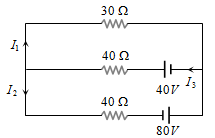
In the given circuit the current I1 is

|
(a) 0.4 A |
(b) – 0.4 A |
(c) 0.8 A |
(d) – 0.8 A |
In frequency modulation
|
(a) The amplitude of modulated wave varies as frequency of carrier wave |
|
(b) The frequency of modulated wave varies as amplitude of modulating wave |
|
(c) The amplitude of modulated wave varies as amplitude of carrier wave |
|
(d) The frequency of modulated wave varies as frequency of modulating wave |
The resistance of 10 metre long potentiometer wire is 1ohm/meter. A cell of e.m.f. 2.2 volts and a high resistance box are connected in series to this wire. The value of resistance taken from resistance box for getting potential gradient of 2.2 millivolt/metre will be
|
(a) 790 Ω |
(b) 810 Ω |
(c) 990 Ω |
(d) 1000 Ω |
In Young's double slit experiment, a glass plate is placed before a slit which absorbs half the intensity of light. Under this case
|
(a) The brightness of fringes decreases |
|
(b) The fringe width decreases |
|
(c) No fringes will be observed |
|
(d) The bright fringes become fainter and the dark fringes have finite light intensity |
The energy of hydrogen atom in its ground state is – 13.6 eV. The energy of the level corresponding to the quantum number n is equal 5 is
|
(a) – 5.40 eV |
(b) – 2.72 eV |
(c) – 0.85 eV |
(d) – 0.54 eV |
A long thin hollow metallic cylinder of radius 'R' has a current i ampere. The magnetic induction 'B'-away from the axis at a distance r from the axis varies as shown in
|
(a) |
(b) |
(c) |
(d) |