Question
Two projectiles are thrown simultaneously in the same plane from the same point. If their velocities are $v_1$ and $v_2$ at angles $\theta _1$ and $\theta_2$ respectively from the horizontal, then answer the following question

If $v_1\,\,cos\,\,\theta _1 = v_2\,\,cos\,\,\theta _2$, then choose the incorrect statement
Answer

Get the step-by-step solution for this question inside the Vidyadip app.

Get the answer in the app

Need a full question paper?

Generate a complete, print-ready paper with questions like this in minutes — across 16+ boards, with answer keys.

Start Generating Free

Similar questions

The distance between two coherent sources is $0.1\,\,mm.$  The fringe-width on a screen $1.2\,\,m$ away from the source is $6.0\,\,mm.$ The wavelength of light used is......$\mathop A\limits^o$
Given radius of Earth $‘R’$ and length of a day $‘T’$ the height of a geostationary satellite is [$G-$Gravitational Constant, $M-$Mass of Earth]
A simple telescope consisting of an objective of focal length $60\,cm$ and a single eye-lens of focal length $5\,cm$ is focused on a distant object in such a way the parallel rays emerge from the eye lens. If the object makes an angle of $2^o$ at the objective the angular width of the image is.....$^o$
A soap bubble of radius $R$ is blown. After heating the solution a second bubble of radius $2R$ is blown. The work required to blow the second bubble in comparison to that required for the first bubble is
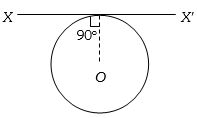
A thin wire of length $L$ and uniform linear mass density $\rho$ is bent into a circular loop with centre at $O$ as shown.  The moment of inertia of the loop about the axis $XX' $ is 
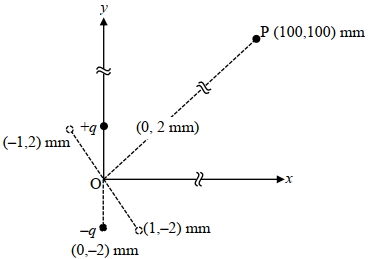
An electric dipole is formed by two charges $+q$ and $-q$ located in xy-plane at $(0,2) \mathrm{mm}$ and $(0,-2) \mathrm{mm}$, respectively, as shown in the figure. The electric potential at point $\mathrm{P}(100,100) \mathrm{mm}$ due to the dipole is $V_0$. The charges $+q$ and $-q$ are then moved to the points $(-1,2) \mathrm{mm}$ and $(1,-2) \mathrm{mm}$, respectively. What is the value of electric potential at $P$ due to the new dipole?
Two balls $A$ and $B$ are placed at the top of $180 \,m$ tall tower. Ball $A$ is released from the top at $t =0 \,s$. Ball $B$ is thrown vertically down with an initial velocity $u$' at $t=2\, s$. After a certain time, both balls meet $100 \,m$ above the ground. Find the value of $u$ in ............... $ms ^{-1}$. [use $g =10 \,ms ^{-2}$ ]
The upper half of an inclined plane of inclination $\theta$ is perfectly smooth while lower half is rough. A block starting from rest at the top of the plane will again come to rest at the bottom, if the coefficient of friction between the block and lower half of the plane is given by 
A uniform thin rope of length $12\, m$ and mass $6\, kg$ hangs vertically from a rigid support and a block of mass $2\, kg$ is attached to its free end. A transverse short wavetrain of wavelength $6\, cm$ is produced at the lower end of the rope. What is the wavelength of the wavetrain (in $cm$ ) when it reaches the top of the rope $?$
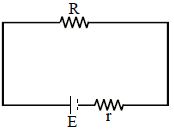
If power in external resistance $R$ is maximum then

$(i) R = r$                              $(ii)$ Power in $R$ is $\frac{{{E^2}}}{{4R}}$

$(iii)$ Input power $\frac{{{E^2}}}{{2R}}$         $(iv)$Efficiency is $50\%$