MCQ
Two protons move parallel to each other, keeping distance $r$ between them, both moving with same  velocity $\vec V\,$. Then the ratio of the electric and magnetic force of interaction between them is
  • $c^2 / v^2$
  • B
    $2c^2 / v^2$
  • C
    $c^2 / 2v^2$
  • D
    None

Answer

Correct option: A.
$c^2 / v^2$
a
Electric force $\mathrm{Fe}=\mathrm{kq}_{1} \mathrm{q}_{2} / \mathrm{r}^{2}=\mathrm{kq}^{2} / \mathrm{r}^{2}$

Magnetic force $=\mathrm{qv}\left(\frac{\mu_{0}}{4 \pi} \times \frac{\mathrm{qv}}{r^{2}}\right)$

$\mathrm{F}_{\mathrm{m}}=\mathrm{q}^{2} \mathrm{v}^{2}\left(\frac{\mu_{0}}{4 \pi}\right) \frac{1}{\mathrm{r}^{2}}$

$\frac{F e}{F_{m}}=\frac{k}{v^{2}\left(\frac{\mu_{0}}{4 \pi}\right)}=\frac{1}{v^{2} \varepsilon_{0} \mu_{0}}=\frac{c^{2}}{v^{2}}$

Need a full question paper?

Generate a complete, print-ready paper with questions like this in minutes — across 16+ boards, with answer keys.

Start Generating Free

Similar questions

In an ammeter, $5 \%$ of the main current passes through the galvanometer. If resistance of the galvanometer is G, the resistance of ammeter will be :
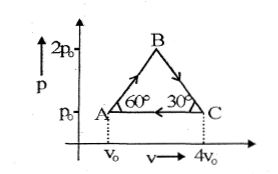
Four moles of an ideal monoatomic gas undergoes a cyclic process $ABCA$ as shown in figure find ratio of temperature of $A$ and $B$ .
Two transparent media having refractive indices $1.0$ and $1.5$ are separated by a spherical refracting surface of radius of curvature $30\,cm$. The centre of curvature of surface is towards denser medium and a point object is placed on the principle axis in rarer medium at a distance of $15\,cm$ from the pole of the surface. The distance of image from the pole of the surface is .......$cm$
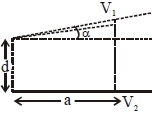
A capacitor is made of two square plates each of side $a$ making a very small angle $\alpha$ between them, as shown in figure. The capacitance will be close to
The length of an iron wire is $L$ and area of cross-section is $A$. The increase in length is $l$ on applying the force $F$ on its two ends. Which of the statement is correct
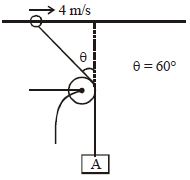
For the given fig. find the speed of block $A$ when $\theta  = {60^o}$
A body of density $\rho$ is dropped from rest from a height $h$ into a lake of density $\sigma$, where $\sigma > \rho$. Neglecting all dissipative forces, the maximum depth to which the body sinks before returning to float on surface ..........
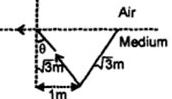
refractive index of medium is
Two identical particles of mass $1\, {kg}$ each go round a circle of radius ${R}$, under the action of their mutual gravitational attraction. The angular speed of each particle is :
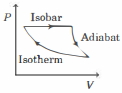
The efficiency of the cycle shown below in the figure (consisting of one isobar, one adiabat and one isotherm) is $50 \%$. The ratio $x$, between the highest and lowest temperatures attained in this cycle obeys (the working substance is an ideal gas)