MCQ
Two pulses having equal and opposite displacements moving in opposite directions overlap at t =t1s. The resultant displacement of the wave at t = t1s is:
  • A
    Twice the displacement of each pulse.
  • B
    Half the displacement of each pulse.
  • C
    Zero.
  • D
    Either (a) or (c).

Answer

  1. Zero.

Explanation:

The displacement due to two pulses will exactly cancel out each other. Thus, there will be no displacement throughout.

Need a full question paper?

Generate a complete, print-ready paper with questions like this in minutes — across 16+ boards, with answer keys.

Start Generating Free

Similar questions

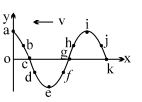
The figure represents the instantaneous picture of a longitudinal harmonic wave travelling along the negative $x$-axis. Identify the correct statement $(s)$ related to the movement of the points shown in the figure. The stationary points are
Water is poured from a height of 10m into an empty barrel at the rate of 1litre per second. If the weight of the barrel is 10kg, the weight indicated at time t = 60s will be:
A block of mass $m$ slides down the plane inclined at angle $30^{\circ}$ with an acceleration $\frac{ g }{4}$. The value of coefficient of kinetic friction will be :
The radii of two planets are respectively ${R_1}$ and ${R_2}$ and their densities are respectively ${\rho _1}$ and ${\rho _2}$. The ratio of the accelerations due to gravity at their surfaces is
Calculate the velocity of a body of a mass 2kg whose linear momentum is 5N s.
An athlete throws a discus from rest to a final angular velocity of $15\, rad\, s^{-1}$ in $0.270\, s$ before releasing it. During acceleration, discus moves a circular arc of radius $0.810\, m$. Acceleration of discus before it is released is ....... $ms^{-2}$.
Which of the following is dimensionally correct
The average degree of freedom per molecule of a gas is $6$. The gas performs $25\  J$ work, while expanding at constant pressure. The heat absorbed by the gas is   .... $J$
Action and reaction:
  1. Act on two different objects.
  2. Have equal magnitude.
  3. Have opposite directions.
  4. Have resultant zero.
A cyclist moves in a circular track of radius $100$ m. If the coefficient of friction is $0.2$, then the maximum velocity with which the cyclist can take the turn with leaning inwards is ...... $m/s$