MCQ
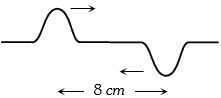
Two pulses in a stretched string whose centres are initially $8 cm$ apart are moving towards each other as shown in the figure. The speed of each pulse is $2 cm/s$. After $2$ seconds, the total energy of the pulses will be
  • A
    Zero
  • Purely kinetic
  • C
    Purely potential
  • D
    Partly kinetic and partly potential

Answer

Correct option: B.
Purely kinetic
b
(b) After $2 sec$ the pulses will overlap completely.

The string becomes straight and therefore does not have any potential energy and its entire energy must be kinetic.

Need a full question paper?

Generate a complete, print-ready paper with questions like this in minutes — across 16+ boards, with answer keys.

Start Generating Free

Similar questions

A liquid does not wet the sides of a solid, if the angle of contact is
The function ${\sin ^2}(\omega t)$ represents
The solid angle subtended by the periphery of an area 1cm2 at a point situated symmetrically at a distance of 5cm from the area is:
A smooth circular groove has a smooth vertical wall as shown in figure. A block of mass $m$ moves against the wall with a speed $v$. Which of the following curve represents the correct relation between the normal reaction on the block by the wall $( N )$ and speed of the block $(v)$ ?
Young’s moduli of two wires $A$ and $B$ are in the ratio $7 : 4$. Wire $A$ is $2\, m$ long and has radius $R$. Wire $A$ is $2\, m$ long and has radius $R$. Wire $B$ is $1.5\, m$ long and has radius $2\, mm$. If the two wires stretch by the same length for a given load, then the value of $R$ is close to ......... $mm$
A car travels a distance $S$ on a straight road in two hours and then returns to the starting point in the next three hours. Its average velocity is
A particle of mass $M=0.2 kg$ is initially at rest in the $x y$-plane at a point $( x =-l, y =-h)$, where $l=10 m$ and $h=1 m$. The particle is accelerated at time $t =0$ with a constant acceleration $a =10 m / s ^2$ along the positive $x$-direction. Its angular momentum and torque with respect to the origin, in SI units, are represented by $\vec{L}$ and $\vec{\tau}$, respectively. $\hat{i}, \hat{j}$ and $\hat{k}$ are unit vectors along the positive $x , y$ and $z$-directions, respectively. If $\hat{k}=\hat{i} \times \hat{j}$ then which of the following statement($s$) is(are) correct?

$(A)$ The particle arrives at the point $(x=l, y=-h)$ at time $t =2 s$.

$(B)$ $\vec{\tau}=2 \hat{ k }$ when the particle passes through the point $(x=l, y=-h)$

$(C)$ $\overrightarrow{ L }=4 \hat{ k }$ when the particle passes through the point $(x=l, y=-h)$

$(D)$ $\vec{\tau}=\hat{ k }$ when the particle passes through the point $(x=0, y=-h)$

The rectangular plate shown in the figure is rotated in turn about $x-x,\, y-y$ and $z-z$ axes passing through its centre of mass $O$ . Its moment of inertia is
A particle is executing $SHM$ along a straight line. Its velocities at distance $x_1$ and $x_2$ from the mean position are $V_1$ and $V_2$ respectively. Its time period is
Morning breakfast gives $5000 \,cal$ to a $60 \,kg$ person. The efficiency of person is $30 \%$. The height upto which the person can climb up by using energy obtained from breakfast is ......... $m$