Question
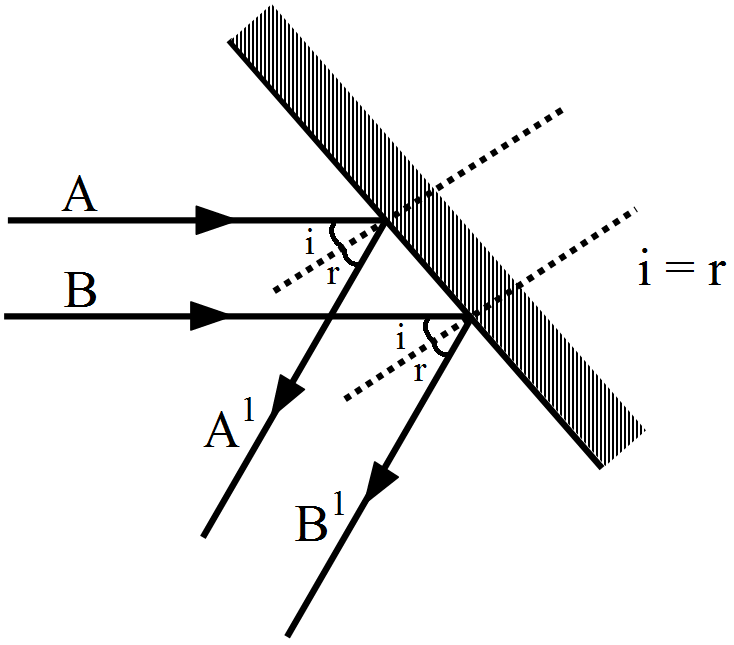
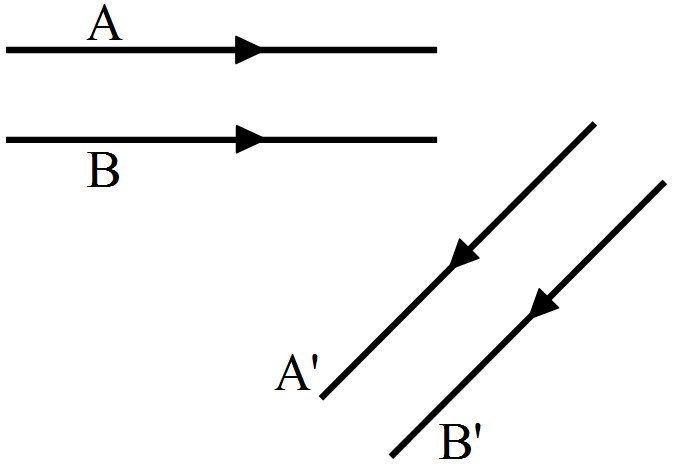
Two rays A and B being reflected by a mirror and going as A' and B'. The mirror:
  1. Is plane.
  2. Is convex.
  3. Is concave.
  4. May be any spherical mirror.

Answer

  1. Is plane.
Explanation:

Here initially A & B is parallel to each other after reflection by teh plane mirror A' & B' goes Parallel to each other.

Need a full question paper?

Generate a complete, print-ready paper with questions like this in minutes — across 16+ boards, with answer keys.
Start Generating Free

Similar questions

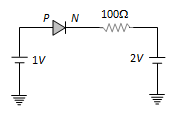
The current through an ideal $PN-$junction shown in the following circuit diagram will be
When was Van de Graff generator invented and by whom?
Let $\text{E}_\text{n}=\frac{-1}{8\epsilon_0^2}\frac{\text{me}^4}{\text{n}^2\text{h}^2}$ be the energy of the nth level of $H-$atom. If all the $H-$atoms are in the ground state and radiation of frequency $\frac{(\text{E}_2-\text{E}_1)}{\text{h}}$ falls on it$:$
A capacitor is a system of two conductors separated by _____.
Maximum useable frequency (MUF) in F-region layer is x, when the critical frequency is 60 MHz and the angle of incidence is 70°. Then x is (a) 150 MHz(b) 170 MHz(c) 175 MHz(d) 190 MHz
       
If an electron is accelerated by $8.8 \times 10^{14} m / s ^2$ , then electric field required for acceleration is $($given specific charge of the electron $=1.76 \times 10^{11} Ckg ^{-1} )Z$
The approximate ratio of resistances in the forward and reverse bias of the $PN-$junction diode is
An air bubble in sphere having $4 \ cm$ diameter appears $1 \ cm$ from surface nearest to eye when looked along diameter. If $_am_g = 1.5,$ the distance of bubble from refracting surface is
Which of the following statements is not true (a) The resistance of intrinsic semiconductors decrease with increase of temperature(b) Doping pure Si with trivalent impurities give P-type semiconductors(c) The majority carriers in N-type semiconductors are  holes(d) A PN-junction can act as a semiconductor diode


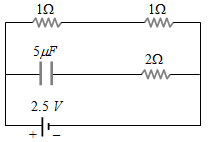
A capacitor of capacitance $5\mu F$ is connected as shown in the figure. The internal resistance of the cell is $0.5 \Omega.$ The amount of charge on the capacitor plate is