MCQ
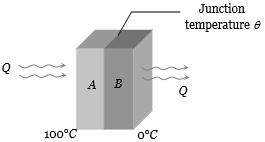
Two rectangular blocks $A$ and $B$ of different metals have same length and same area of cross-section. They are kept in such a way that their cross-sectional area touch each other. The temperature at one end of $A$ is $100°C$ and that of $B$ at the other end is $0°C$ . If the ratio of their thermal conductivity is $1 : 3$ , then under steady state, the temperature of the junction in contact will be ........ $^oC$
  • $25$
  • B
    $50$
  • C
    $75$
  • D
    $100$

Answer

Correct option: A.
$25$
a
(a) It is given that $\frac{{{K_1}}}{{{K_2}}} = \frac{1}{3}$ ==> ${K_1} = K$ then ${K_2} = 3K$
the temperature of the junction in contact
$\theta = \frac{{{K_1}{\theta _1} + {K_2}{\theta _2}}}{{{K_1} + {K_2}}}$$ = \frac{{1 \times 100 + 3 \times 0}}{{1 + 3}} = \frac{{100}}{4}$= $25°C$

Need a full question paper?

Generate a complete, print-ready paper with questions like this in minutes — across 16+ boards, with answer keys.

Start Generating Free

Similar questions

An inclined plane makes an angle of $30^{\circ}$ with the horizontal. A solid sphere rolling down this inclined plane from rest without slipping has a linear acceleration equal to ........
A parachutist after bailing out falls $50\, m$ without friction. When parachute opens, it decelerates at $2\, m/s^2$. He reaches the ground with a speed of $3\, m/s$. At what height, did he bail out ?........$m$
A bubble has surface tension $S$. The ideal gas inside the bubble has ratio of specific heats $\gamma=\frac{5}{3}$. The bubble is exposed to the atmosphere and it always retains its spherical shape. When the atmospheric pressure is $P_{a 1}$, the radius of the bubble is found to be $r_1$ and the temperature of the enclosed gas is $T_1$. When the atmospheric pressure is $P_{a 2}$, the radius of the bubble and the temperature of the enclosed gas are $r_2$ and $T_2$, respectively.

Which of the following statement($s$) is(are) correct?

$(A)$ If the surface of the bubble is a perfect heat insulator, then $\left(\frac{r_1}{r_2}\right)^5=\frac{P_{a 2}+\frac{2 S}{r_2}}{P_{a 1}+\frac{2 S}{r_1}}$

$(B)$ If the surface of the bubble is a perfect heat insulator, then the total internal energy of the bubble including its surface energy does not change with the external atmospheric pressure.

$(C)$ If the surface of the bubble is a perfect heat conductor and the change in atmospheric temperature is negligible, then $\left(\frac{r_1}{r_2}\right)^3=\frac{P_{a 2}+\frac{4 S}{r_2}}{P_{a 1}+\frac{4 S}{r_1}}$.

$(D)$ If the surface of the bubble is a perfect heat insulator, then $\left(\frac{T_2}{T_1}\right)^{\frac{5}{2}}=\frac{P_{a 2}+\frac{4 S}{r_2}}{P_{a 1}+\frac{4 S}{r_1}}$.
A projectile is thrown at an angle $\theta$ with the horizontal and its range is $R_1$. It is then thrown at an angle $\theta$ with vertical and the range is $R_2$, then
A piece of stone is thrown into the air. Acceleration of stone :
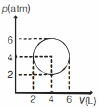
An ideal gas undergoes a circular cycle centred at $4 \,atm , 4 L$ as shown in the diagram. The maximum temperature attained in this process is close to
If the random error in the arithmetic mean of $50$ observations is $\alpha$, then the random error in the arithmetic mean of $150$ observations would be
A ball of mass $m$ is attached to a string whose other end is fixed. The system is free to rotate in vertical plane. When the ball swings, no work is done on the ball by the tension in the string. Which of the following statements is the correct explanation?
Two satellites $A$ and $B$ , having ratio of masses $3 : 1$ are in circular orbits of radius $r$ and $4r$ . Calculate the ratio of total mechanical energy of $A$ and $B$