Two resistance wires on joining in parallel the resultant resistance is $\frac{6}{5}\,ohms$. One of the wire breaks, the effective resistance is $2\,ohms$. The resistance of the broken wire is ............ $ohm$
Medium
Download our app for free and get started
Suppose resistance of wires are ${R_1}$ and ${R_2}$ then $\frac{6}{5} = \frac{{{R_1}{R_2}}}{{{R_1} + {R_2}}}$. If ${R_2}$ breaks then ${R_1} = 2\,\Omega $
Hence, $\frac{6}{5} = \frac{{2 \times {R_2}}}{{2 + {R_2}}} \Rightarrow {R_2} = 3\,\Omega $.

Download our appand get started for free
Experience the future of education. Simply download our apps or reach out to us for more information. Let's shape the future of learning together!No signup needed.*
Similar Questions
- 1View SolutionWhen a potential difference is applied across the ends of a linear metallic conductor
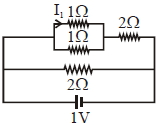
- 2The current $I_{1}$ (in $A$) flowing through $1\; \Omega$ resistor in the following circuit is:View Solution
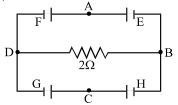
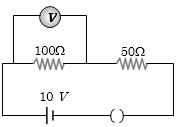
- 3In the given circuit, the voltmeter records $5\, volts$. The resistance of the voltmeter in $ohms$ isView Solution
- 4View SolutionThe drift velocity does not depend upon
- 5View SolutionWhich of the following has a negative temperature coefficient
- 6An electric bulb marked $40\, W$ and $200\, V$, is used in a circuit of supply voltage $100\, V$. Now its power isView Solution
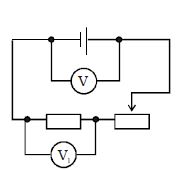
- 7If the rheostat slider were to move from the extreme right to the far left, How will the reading of voltmeter $V_1$ change?View Solution
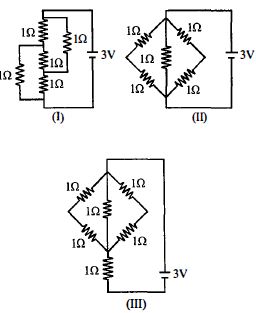
- 8The figure shows three circuits $I, II$ and $III$ which are connected to a $3\,V$ battery. If the powers dissipated by the configurations $I, II$ and $III$ are $P_1 , P_2$ and $P_3$ respectively, thenView Solution
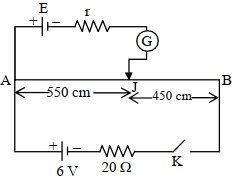
- 9In the given figure, there is a circuit of potentiometer of length $A B=10 \,{m}$. The resistance per unit length is $0.1 \,\Omega$ per ${cm}$. Across ${AB}$, a battery of emf ${E}$ and internal resistance ' ${r}^{\prime}$ is connected. The maximum value of emf measured by this potentiometer is : (In $V$)View Solution
- 10In the circuit shown $E, F, G$ and $H$ are cells of $\mathrm{e.m.f.}$ $2\,V, 1\,V, 3\,V$ and $1\,V$ respectively and their internal resistances are $2\,\Omega , 1\,\Omega , 3\,\Omega$ and $1\,\Omega$ respectively.View Solution