MCQ
Two resistors having equal resistances are joined in series and a current is passed through the combination. Neglect any variation in resistance as the temperature changes. In a given time interval
  •  Equal amounts of thermal energy must be produced in the resistors
  • B
    Unequal amounts of thermal energy may be produced
  • C
     The temperature must rise equally in the resistors
  • D
     The temperature must rise unequally in the resistors
Answer

Correct option: A.
 Equal amounts of thermal energy must be produced in the resistors
 Equal amounts of thermal energy must be produced in the resistors

Need a full question paper?

Generate a complete, print-ready paper with questions like this in minutes — across 16+ boards, with answer keys.

Start Generating Free

Similar questions

In Young's double slit experiment, carried out with light of wavelength l = 5000 Å, the distance between the slits is 0.2 mm and the screen is at 200 cm from the slits. The central maximum is at x = 0. The third maximum (taking the central maximum as zeroth maximum) will be at x equal to
If one of the slits of a standard $YDSE$ apparatus is covered by a thin parallel sided glass slab so that it transmit only one half of the light intensity of the other, then :
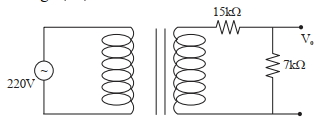
Primary coil of a transformer is connected to $220 \mathrm{~V}$ ac. Primary and secondary turns of the transforms are $100$ and $10$ respectively. Secondary coil of transformer is connected to two series resistance shown in shown in figure. The output voltage $\left(\mathrm{V}_0\right)$ is :
An $\text{LCR}$ series circuit with $100\Omega$ resistance is connected to an ac source of $200V$ and of frequency of $\frac{300 \text{rad}}{\text{s}}$. When only the capacitance is removed, the current lags behind the voltage by $600$. When only the inductance is removed, the current leads the voltage by $60^\circ $ the current through the circuit is:
Power dissipated in an $LCR$ series circuit connected to an $A.C.$ source of $e.m.f$  $\varepsilon$ is
The spectrum of iodine gas under white light will be
The ultimate individual unit of magnetism in any magnet is called
A spherical conductor of radius 2m is charged to a potential of 120 V. It is now placed inside another hollow spherical conductor of radius 6m. Calculate the potential to which the bigger sphere would be raised
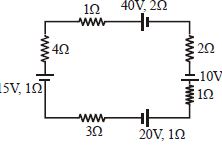
Find the current in the loop.
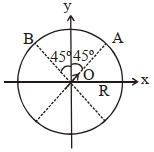
An electric dipole with dipole moment $\frac{p_0}{\sqrt{2}}(\hat{i}+\hat{j})$ is held fixed at the origin $O$ in the presence of an uniform electric field of magnitude $E_0$. If the potential is constant on a circle of radius $R$ centered at the origin as shown in figure, then the correct statement($s$) is/are:

( $\varepsilon_0$ is permittivity of free space, $R \gg$ dipole size)

$(1)$ $R =\left(\frac{ p _0}{4 \pi \varepsilon_0 E _0}\right)^{1 / 3}$

$(2)$ The magnitude of total electric field on any two points of the circle will be same

$(3)$ Total electric field at point $A$ is $\vec{E}_A=\sqrt{2} E_0(\hat{i}+\hat{j})$

$(4)$ Total electric field at point $B$ is $\vec{E}_B=0$