Question
Two resistors whose value are in ratio 2 : 1 are connected in parallel with one cell.  Then ratio of power dissipated is(a) 2 : 1(b) 4 : 1(c) 1 : 2    (d) 1 : 1
       

Answer

(c) 1 : 2    

Need a full question paper?

Generate a complete, print-ready paper with questions like this in minutes — across 16+ boards, with answer keys.
Start Generating Free

Similar questions

The index of refraction of diamond is $2.0,$ velocity of light in diamond in $cm$ second is approximately
A point source of light is used in a photoelectric effect. If the source is removed farther from the emitting metal, the stopping potential:
  1. Will increase.
  2. Will decrease.
  3. Will remain constant.
  4. Will either increase or decrease.
An electron enters perpendicular to a uniform magnetic field. The path of the electron will be :
A bar magnet is placed north-south with its north pole due north. The points of zero magnetic field will be in which direction from the centre of the magnet(a) North and south(b) East and west(c) North-east and south-west(d) North-west and south-east
   
   
To obtain maximum EMF from a number of cells, they must be connected in.
Two charged spheres of radii 10 cm and 15 cm are connected by a thin wire. No current will flow, if they have(a) The same charge on each(b) The same potential(c) The same energy(d) The same field on their surfaces
   
   
A charged particle moves in a gravity-free space without change in velocity. Which of the following is are possible:
  1. $\text{E}=0,\ \text{B}=0$
  2. $\text{E}=0,\ \text{B}\not=0$
  3. $\text{E}\not=0,\ \text{B}=0$
  4. $\text{E}\not=0,\ \text{B}\not=0$
A photon and an electron have equal energy $ E\ \lambda_{\text {photon }} / \lambda_{\text {electron }}$ is proportional to
A circular loop of radius $0.0157m$ carries a current of $2.0\ \text{amp.}$ The magnetic field at the centre of the loop is $\left(\mu_0=4 \pi \times 10^{-7}\right. \ce{weber / amp - m} )$
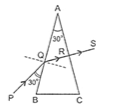
In the diagram, a prism of angle $30^{\circ}$ is used. A ray $PQ$ is incident as shown. An emergent ray $RS$ emerges perpendicular to the second face. The angle of deviation is:
Image