MCQ
Two samples $A$ and $B$ are initially kept in the same state. Sample $A$ is expanded through an adiabatic process and the sample $B$ through an isothermal process. The final volumes of the samples are the same. The final pressures in $A$ and $B$ are $p_A$ and $p_{B }$ respectively.
  • A
    $p_A > p_B$
  • B
    $p_A = p_B$
  • $p_A < p_B$
  • D
    The relation between $p_A$ and $p_B$ cannot be deduced.
Answer

Correct option: C.
$p_A < p_B$

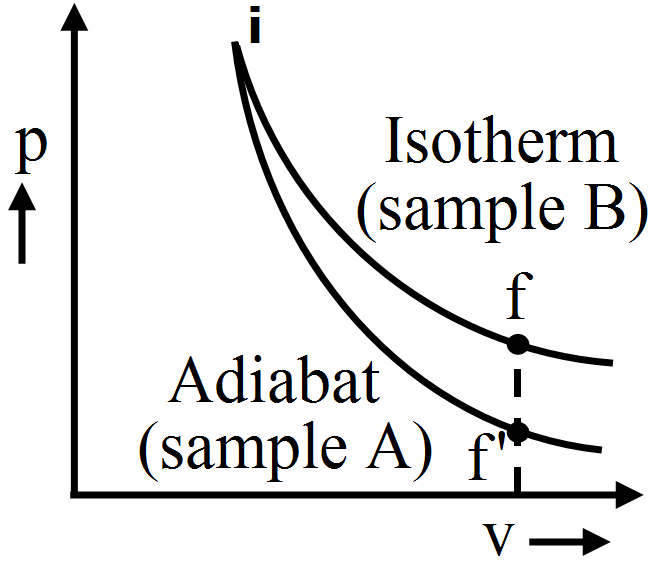
Let the initial states of samples $A$ and $B$ be $i$ and the final states of samples $B$ and $A$ be $f$ and $f',$ respectively.
Let the final volumes of both be $V_o$.
As sample $A$ is expanded through an adiabatic process, its curve in the $p-V$ diagram is steeper than that of sample $B,$ which is expanded through an isothermal process.
Therefore, from the $p-V$ diagram, $p_A < p_B.$

Need a full question paper?

Generate a complete, print-ready paper with questions like this in minutes — across 16+ boards, with answer keys.

Start Generating Free

Similar questions

An uncharged capacitor is connected to a battery. On charging the capacitor(a) All the energy supplied is stored in the capacitor(b) Half the energy supplied is stored in the capacitor(c) The energy stored depends upon the capacity of the capacitor only(d) The energy stored depends upon the time for which the capacitor is charged


A parallel$-$plate capacitor has plates of unequal area. The larger plate is connected to the positive terminal of the battery and the smaller plate to its negative terminal. Let $Q_+$ and $Q_-$ be the charges appearing on the positive and negative plates respectively:
If a glass prism is dipped in water, its dispersive power:
Consider an npn transitor with its base-emitter junction forward biased and collector base junction reverse biased. Which of the following statements are true?
If in a series $L - C - R$ ac circuit, the voltages across $L, C$ and $R$ are $V_1​, V_{2​}$ and $V_3​$ respectively, then the voltage of the source is always.
An inductor of reactance $1\Omega$ and a resistor of $2\Omega$ are connected in series to the terminals of a $6V (rms)\ a.c.$ source. The power dissipated in the circuit is:
On installing forward bias on $P - N$ junction, its behavior will be :
A metallic block carrying current $I$ is subjected to a uniform magnetic induction $\overrightarrow{B}$ as shown in the figure. The moving charges experience a force $\overrightarrow{F}$ given by $.........$ which results in the lowering of the potential of the face $........$ Assume the speed of the carriers to be $v$
The forces in which sum of kinetic energy and potential energy is conserved are called as:
The pointer of a dead-beat galvanometer gives a steady deflection because(a) Eddy currents are produced in the conducting frame over which the coil is wound(b) Its magnet is very strong(c) Its pointer is very light(d) Its frame is made of abonite