Question
Two samples A and B are initially kept in the same state. Sample A is expanded through an adiabatic process and the sample B through an isothermal process. The final volumes of the samples are the same. The final pressures in A and B are pA and prespectively.
  1. pA > pB
  2. pA = pB
  3. pA < pB
  4. The relation between pA and pB cannot be deduced.
Answer

  1. pA < pB

Explanation:

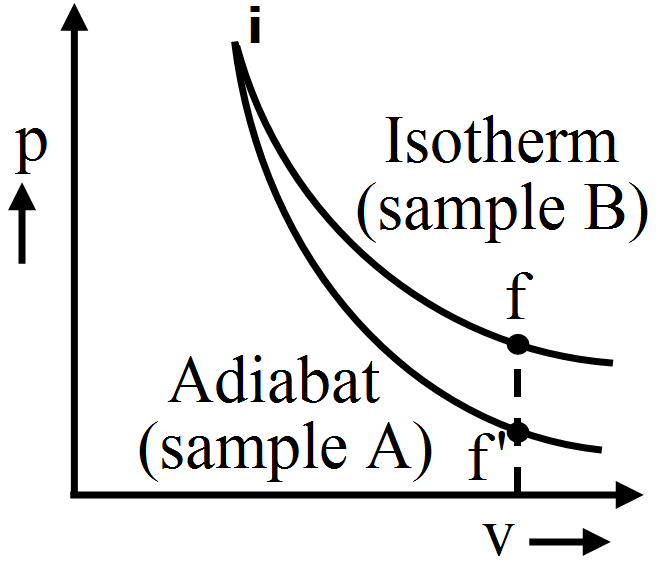
Let the initial states of samples A and B be i and the final states of samples B and A be f and f', respectively. Let the final volumes of both be Vo. As sample A is expanded through an adiabatic process, its curve in the p-V diagram is steeper than that of sample B, which is expanded through an isothermal process. Therefore, from the p-V diagram, pA < pB.

Need a full question paper?

Generate a complete, print-ready paper with questions like this in minutes — across 16+ boards, with answer keys.

Start Generating Free

Similar questions

A river is flowing from east to west at a speed of $5\, m/min$ A man on south bank of river, capable of swimming $10\,m/min$ in still water, wants to swim across the river in shortest time. He should swim
The Doppler's effect is applicable for
Speed of sound at constant temperature depends on
The speed at the maximum height of a projectile is half of its initial speed $u$. The horizontal range of projectile is
The work done by a force $\vec F = \left( { - 6{x^3}\hat i} \right)\,N$, in displacing a particle from $x = 4\, m$ to $x = -2\, m$ is  ................ $\mathrm{J}$
A parallel beam of light is incident on a tank filled with water up to a height of $61.5 \,mm$ as shown in the figure below. Ultrasonic waves of frequency $0.5 \,MHz$ are sent along the length of the water column using a transducer placed at the top and they form longitudinal standing waves in the water. Which of the schematic plots below best describes the intensity distribution of the light as seen on the screen? (Take, the speed of sound in water to be $1500 \,m / s$ )
A reversible cyclic process for an ideal gas is shown below. Here, $P, V$, and $T$ are pressure, volume and temperature, respectively. The thermodynamic parameters $q, w, H$ and $U$ are heat, work, enthalpy and internal energy, respectively.

(image)

The correct option ($s$) is (are)

$(A)$ $q_{A C}=\Delta U_{B C}$ and $W_{A B}=P_2\left(V_2-V_1\right)$

$(B)$ $\mathrm{W}_{\mathrm{BC}}=\mathrm{P}_2\left(\mathrm{~V}_2-\mathrm{V}_1\right)$ and $\mathrm{q}_{\mathrm{BC}}=\mathrm{H}_{\mathrm{AC}}$

$(C)$ $\Delta \mathrm{H}_{\mathrm{CA}}<\Delta \mathrm{U}_{\mathrm{CA}}$ and $\mathrm{q}_{\mathrm{AC}}=\Delta \mathrm{U}_{\mathrm{BC}}$

$(D)$ $\mathrm{q}_{\mathrm{BC}}=\Delta \mathrm{H}_{\mathrm{AC}}$ and $\Delta \mathrm{H}_{\mathrm{CA}}>\Delta \mathrm{U}_{\mathrm{CA}}$

A source of frequency $\nu$ gives $5$ beats/second when sounded with a source of frequency $200 \;Hz$. The second harmonic of frequency $2\nu$ of source gives $10$ beats/second when sounded with a source of frequency $420\; Hz$. The value of $v$ is .... $Hz$
The correct increasing order for modulus of elasticity for copper, steel, glass and rubber is
$250\; N$ force is required to raise $75 \;kg$ mass from a pulley. If rope is pulled $12 \;m$ then the load is lifted to $3 \;m$, the efficiency of pulley system will be ......$\%$