- pA > pB
- pA = pB
- pA < pB
- The relation between pA and pB cannot be deduced.
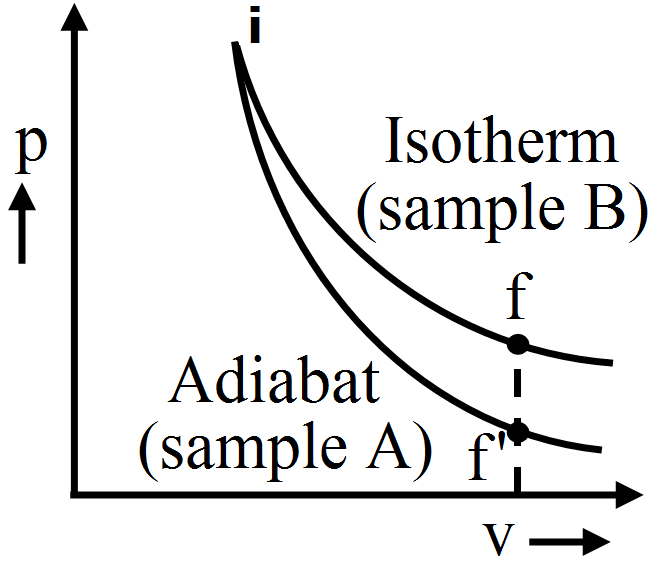
Explanation:

Let the initial states of samples A and B be i and the final states of samples B and A be f and f', respectively. Let the final volumes of both be Vo. As sample A is expanded through an adiabatic process, its curve in the p-V diagram is steeper than that of sample B, which is expanded through an isothermal process. Therefore, from the p-V diagram, pA < pB.
Generate a complete, print-ready paper with questions like this in minutes — across 16+ boards, with answer keys.
A light ray is incident by grazing one of the face of a prism and after refraction ray does not emerge out, what should be the angle of prism while critical angle is C
|
(a) Equal to 2C |
(b) Less than 2C |
(c) More than 2C |
(d) None of the above |
Photoelectric emission is observed from a metallic surface for frequencies
and
of the incident light rays (
. If the maximum values of kinetic energy of the photoelectrons emitted in the two cases are in the ratio of 1 : k, then the threshold frequency of the metallic surface is
|
(a) |
(b) |
(c) |
(d) |
A plane mirror reflecting a ray of incident light is rotated through an angle θ about an axis through the point of incidence in the plane of the mirror perpendicular to the plane of incidence, then
|
(a) The reflected ray rotates through an angle 2θ |
| (b) The incident ray is fixed |
| (c) The reflected ray does not rotate |
| (d) a, b |
If a proton is projected in a direction perpendicular to a uniform magnetic field with velocity v and an electron is projected along the lines of force, what will happen to proton and electron
|
(a) The electron will travel along a circle with constant speed and the proton will move along a straight line |
|
(b) Proton will move in a circle with constant speed and there will be no effect on the motion of electron |
|
(c) There will not be any effect on the motion of electron and proton |
|
(d) The electron and proton both will follow the path of a parabola |
The equation
is
|
(a) b -emission |
(b) a -emission |
(c) e– capture |
(d) Fission |
In a transformer, the number of turns in primary coil and secondary coil are 5 and 4 respectively. If 240 V is applied on the primary coil, then the ratio of current in primary and secondary coil is
|
(a) 4 : 5 |
(b) 5 : 4 |
(c) 5 : 9 |
(d) 9 : 5 |
