MCQ
Two sound sources when sounded simultaneously produce four beats in $0.25$ second. the difference in their frequencies must be
  • A
    $4$
  • B
    $8$
  • $16$
  • D
    $1$

Answer

Correct option: C.
$16$
c
(c) No. of beats = frequency difference = $\frac{4}{{0.25}} = 16$

Need a full question paper?

Generate a complete, print-ready paper with questions like this in minutes — across 16+ boards, with answer keys.
Start Generating Free

Similar questions

A particle moves in a straight line so that its displacement $x$ at any time $t$ is given by $x^2=1+t^2$. Its acceleration at any time $\mathrm{t}$ is $\mathrm{x}^{-\mathrm{n}}$ where $\mathrm{n}=$ . . . . .
One gm mol of a diatomic gas $(\gamma = 1.4)$ is compressed adiabatically so that its temperature rises from ${27^o}C$ to ${127^o}C$. The work done will be
Two sources of sound $A$ and $B$ produces the wave of $350 Hz$, they vibrate in the same phase. The particle $P$ is vibrating under the influence of these two waves, if the amplitudes at the point $P$ produced by the two waves is $0.3 mm$ and $0.4 mm,$ then the resultant amplitude of the point $P$ will be when $AP -BP = 25 cm$ and the velocity of sound is $350 m/sec$  .... $mm$
The work done in increasing the length of a $1$ $metre$ long wire of cross-section area $1\, mm^2$ through $1\, mm$ will be ....... $J$ $(Y = 2\times10^{11}\, Nm^{-2})$
Let $\text{n}_\text{p}$ and $\text{n}_\text{e}$ be the number of holes and conduction electrons in an intrinsic semiconductor.
Given : $\vec A\, = \,2\hat i\, + \,p\hat j\, + q\hat k$ and $\vec B\, = \,5\hat i\, + \,7\hat j\, + 3\hat k,$ if $\vec A\,||\,\vec B,$ then the values of $p$ and $q$ are, respectively
In Millikan's oil drop experiment, what is viscous force acting on an uncharged drop of radius $2.0 \times 10^{-5}\, {m}$ and density $1.2 \times 10^{3} \,{kgm}^{-3}$ ? Take viscosity of liquid $=1.8 \times 10^{-5}\, {Nsm}^{-2} .$ (Neglect buoyancy due to air).
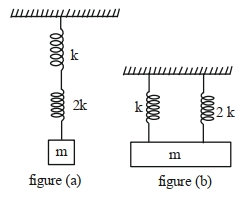
As per given figures, two springs of spring constants $K$ and $2\,K$ are connected to mass $m$. If the period of oscillation in figure $(a)$ is $3 s$, then the period of oscillation in figure $(b)$ will be $\sqrt{ x }$ s. The value of $x$ is$.........$
A ball of mass $3\ kg$ collides with a wall with velocity $10m/ \sec$ at an angle of $30^\circ$ with the wall and after collision reflects at the same angle with the same speed. The change in momentum of ball in $\text{MKS}$ unit is:
A force $\vec{F}=(40 \hat{i}+10 \hat{j})\, N$ acts on a body of mass $5\, {kg}$. If the body starts from rest, its position vector $\vec{r}$ at time $t=10\, {s}$, will be -