MCQ
Two sources are called coherent if they produce waves:
  • A
    Of equal wavelength.
  • B
    Of equal velocity.
  • C
    Having same shape of wavefront.
  • Having a constant phase difference.

Answer

Correct option: D.
Having a constant phase difference.

For light waves emitted by two sources of light to remain coherent, the initial phase difference between waves should remain constant in time. If the phase difference changes continuously or randomly with time, then the sources are incoherent.

Need a full question paper?

Generate a complete, print-ready paper with questions like this in minutes — across 16+ boards, with answer keys.
Start Generating Free

Similar questions

The work done by all the forces (external and internal) on a system equals the change in:
The impurity atoms with which pure silicon may be doped to make it a p-type semiconductor are those of:
A ray of light is incident on the hypotenuse of a right-angled prism after travelling parallel to the base inside the prism. If $\mu$ is the refractive index of the material of the prism, the maximum value of the base angle for which light is totally reflected from the hypotenuse is
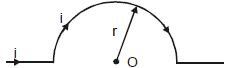
A portion of a conductive wire is bent in the form of a semicircle of radius $r$ as shown below in fig. At the centre of semicircle, the magnetic induction will be
A planet of mass $m$ moves in an ellipse around the sun of mass ${M_S}$ so that its maximum and minimum distances are ${r_1}$ and ${r_2}$ respectively. The angular momentum of the planet relative to the centre of the sun is
In P-type semiconductor the majority and minority charge carriers are respectively
Because we cannot ever know the initial conditions of groups of objects with perfect precision, the later behaviour of complex systems of objects may be almost completely unpredictable, even the wonderfully successful equations derived from Newtonian mechanics.
The previous statement describes the essence of which theory?
Assertion : We can measure the potential barrier of a PN junction by putting a sensitive voltmeter across its terminals.
Reason : The current through the PN junction is not same in forward and reversed bias.
An object is placed in front of a symmetrical convex lens with refractive index $1.5$ and radius of curvature $40\,cm$. The surface of the lens further away from the object is silvered. Under auto-collimation condition, the object distance is.......$cm$
A lens of power $+2$ diopters is placed in contact with a lens of power $-1$ diopter. The combination will behave like