Two springs of force constants $300\, N/m$ (Spring $A$) and $400\, N/m$ (Spring $B$) are joined together in series . The combination is compressed by $8.75\, cm$. The ratio of energy stored in $A$ and $B$ is $\frac{{{E_A}}}{{{E_B}}}$. Then $\frac{{{E_A}}}{{{E_B}}}$ is equal to
JEE MAIN 2013, Diffcult


Download our appand get started for free
Experience the future of education. Simply download our apps or reach out to us for more information. Let's shape the future of learning together!No signup needed.*
Similar Questions
- 1Two pendulums differ in lengths by $22\,cm$ . They oscillate at the same place such that one of them makes $15\,oscillations$ and the other makes $18\,oscillations$ during the same time. The lengths (in $cm$ ) of the pendulums areView Solution
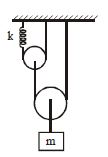
- 2What is the period of small oscillations of the block of mass $m$ if the springs are ideal and pulleys are massless ?View Solution
- 3The motion of a particle executing $S.H.M.$ is given by $x = 0.01\sin 100\pi (t + .05)$, where $x$ is in metres and time is in seconds. The time period is ..... $\sec$View Solution
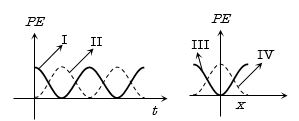
- 4For a particle executing $S.H.M.$ the displacement $x$ is given by $x = A\cos \omega t$. Identify the graph which represents the variation of potential energy $(P.E.)$ as a function of time $t$ and displacement $x$View Solution
- 5Values of the acceleration $A$ of a particle moving in simple harmonic motion as a function of its displacement $x$ are given in the table below. The period of the motion isView Solution
$A (mm \,\,s^{-2}$) $16$
$8$
$0$
$- 8$
$- 16$
$x\;(mm)$
$- 4$
$- 2$
$0$
$2$
$4$
- 6A simple pendulum oscillates in air with time period $T$ and amplitude $A$. As the time passesView Solution
- 7A particle is oscillating according to the equation $X = 7\cos 0.5\pi t$, where $t$ is in second. The point moves from the position of equilibrium to maximum displacement in time ..... $\sec$View Solution
- 8When the potential energy of a particle executing simple harmonic motion is one-fourth of its maximum value during the oscillation, the displacement of the particle from the equilibrium position in terms of its amplitude $a$ isView Solution
- 9A particle executes $S.H.M.$ with amplitude $'a'$ and time period $V$. The displacement of the particle when its speed is half of maximum speed is $\frac{\sqrt{ x } a }{2} .$ The value of $x$ is $\ldots \ldots \ldots$View Solution
- 10$2$ particles $p$ and $q$ describe $SHM$ of same amplitude $a$ and same frequency $f$ along straight line, the maximum distance between the two particle $a\sqrt 2 $ . The initial phase difference between particle isView Solution