Question
Two statements are given-one labelled Assertion (A) and the other labelled Reason (R). Select the correct answer to these questions from the codes (a), (b), (c) and (d) as given below.
  1. Both A and R are true and R is the correct explanation of A.
  2. Both A and R are true but R is not the correct explanation of A.
  3. A is true but R is false.
  4. A is false and R is also false.
Assertion: Optical fibers are used to transmit light without any loss in its intensity over distance of several kilometers.
Reason: Optical fibers are very thick and all the light is passed through it without any loss.
Answer

  1. A is true but R is false.
Explantion:
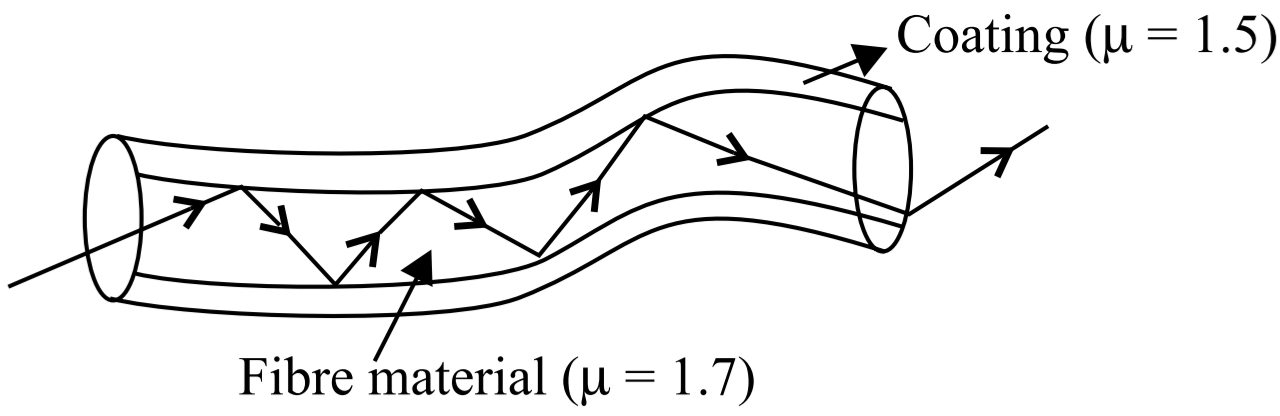
Optical fiber is extremely thin (radius of few microns) and long strand of very fine quality glass or quartz. When tight is incident at a small angle at one end, it gets refracted into the strands (or fibres) and incident on the interface of the fibres and the coating. The angle of incidence being greater than the critical angle, the ray of light undergoes total internal reflections. It suffers the internal reflection again and again, till the angle of incidence remains greater than the critical angle for fibre material with respect to coating. Due to successive total internal reflection there is no loss of intensity in optical fibres.

Need a full question paper?

Generate a complete, print-ready paper with questions like this in minutes — across 16+ boards, with answer keys.

Start Generating Free

Similar questions

Two statements are given-one labelled Assertion(A) and the other labelled Reason (R). Select the correct answer to these questions from the codes(a), (b), (c) and (d) as given below.
  1. Both A and R are true and R is the correct explanation of A.
  2. Both A and R are true but R is NOT the correct explanation of A.
  3. A is true but R is false.
  4. A is false and R is also false.
Assertion (A): Earth's magnetic field does not affect the working of a moving coil galvanometer.
Reason (R): The earth's magnetic field is quite weak as compared to magnetic field produced in the moving coil galvanometer.
Two statements are given-one labelled Assertion (A) and the other labelled Reason (R). Select the correct answer to these questions from thecodes(a), (b), (c) and (d) as given below.
  1. Both A and R are true and R is the correct explanation of A.
  2. Both A and R are true but R is not the correct explanation of A.
  3. A is true but R is false.
  4. A is false and R is also false.
Assertion: Silicon is preferred over germanium for making semiconductor devices.
Reason: The energy band for germanium is more than the energy band of silicon.
For two statements are given-one labelled Assertion (A) and the other labelled Reason (R). Select the correct answer to these questions from the codes (a), (b), (c) and (d) as given below.
  1. Both A and R are true, and R is the correct explanation of A.
  2. Both A and R are true, but R is not the correct explanation of A.
  3. A is true, but R is false.
  4. A is false, and R is also false.
Assertion (A): Capacity of a parallel plate capacitor increases when distance between the plates is decreased.
Reason (R): Capacitance of capacitor is inversely proportional to distance between them.
For two statements are given-one labelled Assertion (A) and the other labelled Reason (R). Select the correct answer to these questions from the codes (a), (b), (c) and (d) as given below.
  1. Both A and R are true, and R is the correct explanation of A.
  2. Both A and R are true, but R is not the correct explanation of A.
  3. A is true, but R is false.
  4. A is false, and R is also false.
Assertion: The current in a wire is due to flow of free electrons in a definite direction.
Reason: A current carrying wire should have non-zero charge.
For question, statements are given$-$one labelled Assertion $(A)$ and the other labelled Reason $(R).$ Select the correct answer to these questions from the codes $(a) (b) (c)$ and $(d)$ as given below.
Assertion $(A):$ Cadmium rods, used in a nuclear reactor, control the rate of fission.
Reason $(R):$ Cadmium rods, used in a nuclear reactor, control the rate of fission.
Assertion (A): An electric lamp is connected in series with a long solenoid of copper with air core and then connected to ac source. If an iron rod is inserted in solenoid, the lamp will become dim.
Reason (R): If an iron rod is inserted in solenoid, the inductance of solenoid increases.
For question two statements are given-one labelled Assertion (A) and the other labelled Reason (R). Select the correct answer to these questions from the codes (a), (b), (c) and (d) as given below.
  1. Both A and R are true, and R is the correct explanation of A.
  2. Both A and R are true, but R is NOT the correct explanation of A.
  3. A is true, but R is false.
  4. A is false and R is also false.
Assertion (A): Total energy of revolving electron in any stationary orbit is negative.
Reason (R): Energy is a scalar quantity. It can have positive or negative value.
Assertion (A) : The quantity L/R possesses the dimension of time.
Reason (R): In order to reduce the rate of increase of current through a solenoid, we should increase the time constant.
For question two statements are given$-$one labelled Assertion $(A)$ and the other labelled Reason $(R).$ Select the correct answer to these questions front the codes $(a), (b), (c)$ and $(d)$ as given below.
Assertion $(A):$ Mass of moving photon varies inversely to the wavelength.
Reason $(R):$ Energy of the particle $=$ Mass $\times ($Speed of light$)^2$​​​​​​​
For question two statements are given-one labelled Assertion (A) and the other labelled Reason (R). Select the correct answer to these questions from the codes (a), (b), (c) and (d) as given below.
  1. Both A and R are true and R is the correct explanation of A.
  2. Both A and R are true but R is NOT the correct explanation of A.
  3. A is true but R is false.
  4. A is false and R is also false.
Assertion (A): One of the condition for interference is that the two source should be very narrow.
Reason (R): One broad source is equal to large number of narrow sources.