MCQ
Two statements are given$-$one labelled Assertion and the other labelled Reason. Select the correct answer to these questions from the codes $(a), (b), (c)$ and $(d)$ as given below.
Assertion: Immobilised yeasts cause less fermentation.
Reason: Brewer's yeast produces beer not wine.
  • A
    Both assertion and reason are true and reason is the correct explanation of assertion.
  • B
    Both assertion and reason are true but reason is not the correct explanation of assertion.
  • C
    Assertion is true but reason is false.
  • Both assertion and reason are false.

Answer

Correct option: D.
Both assertion and reason are false.
In immobilised fermentation process, living yeast cells are immobilised in calcium alginate beads. The beads containing living cells are kept in columns in the fermentation tank. The technique allows quicker fermentation about $20$ times as compared to batch process. The fermentation rapidly becomes vigorous with the evolution of large quantities of $\ce{CO_2}$. Different kinds of alcoholic beverages are produced by using different brewer's yeast and the fermenting medium. For example $- (I)$ Beer is an undistilled product of grain$-$mesh fermentation brought about by Saccharomyces cerevisiae andS. carisbergensis, $(II)$ wine is an undistilled product of fruit juice fermentation brought about by Saccharomyces eliipsoidens.

Need a full question paper?

Generate a complete, print-ready paper with questions like this in minutes — across 16+ boards, with answer keys.

Start Generating Free

Similar questions

Read the following and answer any four questions from $(i)$ to $(v)$ given below:
The pollen grains or microspores are the male reproductive bodies of a flower and are contained in the pollen sac or microsporangia. Each pollen grain consists of a single microscopic cell, possessing two coats: the exine and the in tine. The exine of a pollen grain is made of chemically stable material. Because of this, pollen grains are often very well preserved for thousands of years in soil and sediments.
  1. One of the most resistant biological material present in the exine of pollen grain is:
  1. Pectocellulose.
  2. Sporopollenin.
  3. Suberin.
  4. Cellulose.
  1. The exine possesses one or more thin places known as:
  1. Raphe.
  2. Germ pores.
  3. Hilum.
  4. Endothecium.
  1. What is the function of germ pore?
  1. Emergence of radicle.
  2. Absorption of water for seed germination.
  3. Initiation of pollen tube.
  4. All of these.
  1. What is the key advantage to the plant for having such strong pollen grain walls?
  1. It protects the vital genetic material in the pollen grain.
  2. It allows pollen to serve as a valuable fossil record for the study of ancient plants.
  3. It prevents the pollen tube from growing out before the pollen grain reaches the stigma of a compatible species.
  4. It gives weight to the pollen grain, allowing it to cling better to the body surfaces of insect pollinators.
  1. The number of germ pores in dicots and monocots respectively are:
  1. One and three.
  2. Three and two.
  3. Two and three.
  4. Three and one.
For question two statements are given-one labelled Assertion and the other labelled Reason. Select the correct answer to these questions from the codes $\text{(a), (b), (c)}$ and $(d)$ as given below.
Assertion: Epistasis does not show normal dihybrid ratio, i.e., $9 : 3 : 3 : 1$.
Reason: A gene suppresses the phenotypic expression of a non-allelic gene.
For question two statements are given$-$one labelled Assertion and the other labelled Reason. Select the correct answer to these questions from the codes $(a), (b), (c)$ and $(d)$ as given below.
Assertion : $Y$ chromosome causes maleness.
Reason: If the number of $X$ chromosome is more than one, femaleness dominates.
Read the following and answer any four questions from $(i)$ to $(v)$ given below:
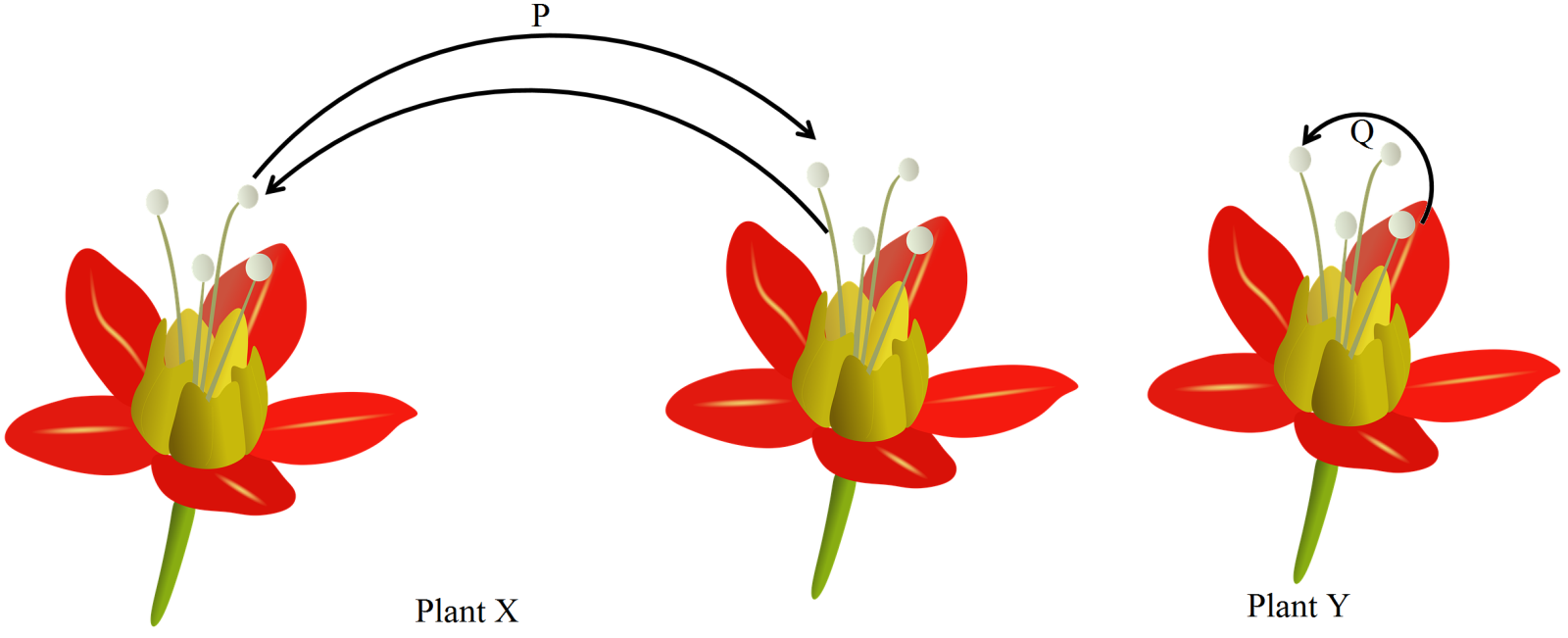
In angiosperms, the pollen grains are being transferred from the anther to the stigma and is termed pollination. This phenomenon was first discovered by Camerarius $(1694)$ in the end of seventeenth century. Pollen grains are immobile. They cannot reach the stigma by themselves. An external agent is required for this. The pollination is mainly of two types$-$self pollination and cross pollination. The diagram given below shows two plants of the same species showing different types of pollination.
  1. What is transferred between the plants in the process indicated by arrow $P?$
  1. Ova.
  2. Pollen.
  3. Nutrients.
  4. Seeds.
  1. Which of the following statements is correct regarding processes $P, Q$ and $R?$
  1. Processes $P, Q$ and $R$ introduce genetic variability in the offspring of sexually reproducing plants $X$ and $Y.$
  2. Wind serves as agent for process $Q$ if plants $X$ and $Y$ belong to Genus Salvia.
  3. Flowers of plants $X$ and $Y$ need to produce odour and nectar for completion of processes $P$ and $Q$ if they are entomophilous.
  4. If plants $X$ and $Y$ belong to Genus Cannabis, then their flowers need to produce sticky and heavy pollens in very small amount for accomplishment of process $Q.$
  1. Identify the processes $P, Q$ and $R.$
S. No $P$ $Q$ $R$
$(a)$
Geitonogamy
Xenogamy
Autogamy
$(b)$
Allogamy
Chasmogamy
Cleistogamy
$(c)$
Autogamy
Geitonogamy
Xenogamy
$(d)$
Geitonogamy
Allogamy
Autogamy
  1. In Catliarantl1us, the growth of style brings the stigma in contact of ripe anthers present on the mouth of corolla tube. This is an example of:
  1. Homogamy.
  2. Cleistogamy.
  3. Geitonogamy.
  4. Xenogamy.
  1. Which of the given processes represents a type of pollination that would result in greater adaptability of the particular species to potential environmental changes?
  1. $P.$
  2. $Q.$
  3. $R.$
  4. All of these.
For question two statements are given$-$one labelled Assertion and the other labelled Reason. Select the correct answer to these questions from the codes $(a), (b), (c)$ and $(d)$ as given below.
Assertion: In some Drosophila, bilateral gynandromorphs are found.
Reason: The gynandromorphs are formed by an irregularity in mitosis at the first cleavage of the zygote.
For two statements are given$-$one labelled Assertion and the other labelled Reason. Select the correct answer to these questions from the codes $(a), (b), (c)$ and $(d)$ as given below.
Assertion: Self-sterility inhibits self$-$pollination.
Reason: Dichogamy is the condition in which only self$-$pollination occurs.
For question two statements are given-one labelled Assertion and the other labelled Reason. Select the correct answer to these questions from the codes $\text{(a), (b), (c)}$ and $(d)$ as given below.
Assertion : The principle of segregation given by Mendel is the principle of purity of gametes.
Reason : Gametes are pure for a character.
For two statements are given$-$one labelled Assertion and the other labelled Reason. Select the correct answer to these questions from the codes $(a), (b), (c)$ and $(d)$ as given below.
Assertion: A medical termination of pregnancy is legally allowed upto the $28^{th}$​​​​​​​ week of pregnancy.
Reason: $\text{MTP}$ is done if family physician or gynaecologist consider the need for abortion.
Directions: In the following questions, the Assertions $(A)$ and Reason$(s) (R)$ have been put forward. Read both the statements carefully and choose the correct alternative from the following:
Assertion: $\text{XX - XY}$ type of sex determination mechanism is an example of female heterogamety and is found in Drosophila.
Reason: Male heterogamety is seen in moths where males produce two different types of gamete.
Read the following and answer any four questions from $(i)$ to $(v)$ given below:
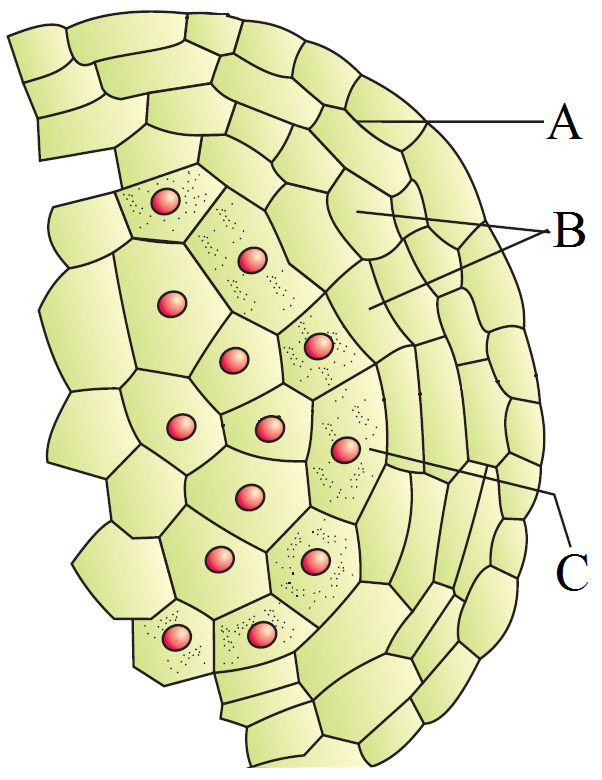
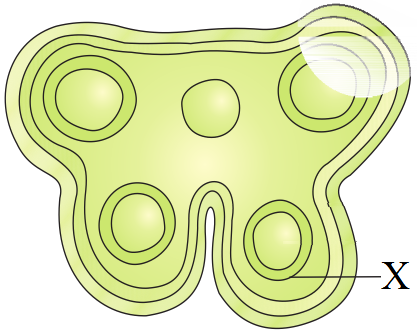
The anther is a four$-$sided structure consisting of four microsporangia located at the corners, two in each lobe. $TI1e$ microsporangia develop further and become pollen sacs. In a transverse section, a typical microsporangium appears near circular in outline. It is generally surrounded by four wall layers$-$the epidermis, endothecium, middle layers and the tapetum.
  1. A dithecous another consists of $(A)$ microsporangia, $(B)$ in each lobe.
Select the option that correctly fills the blanks.
S. No
$A$ $B$
$(a)$
Four
Two
$(b)$
Two
One
$(c)$
Two
Two
$(d)$
Four
One
  1. The given diagram shows microsporangium of a mature anther. Identify $A, B$ and $C.$
$(a)$
$A-$Middle layer
$B-$Endothecium
$C-$Tapetum
$(b)$
$A-$Endothecium
$B-$Tapetum
$C-$ Middle layer
$(c)$
$A-$Endothecium
$B-$Middle layer
$C-$Tapetum
$(d)$
$A-$Tapetum
$B-$Middle layer
$C-$Endothecium
  1. The function of labelled part $X$ is:
  1. Dehiscence.
  2. Mechanical.
  3. Nutrition.
  4. Protection.
  1. Select the incorrect statement.
  1. Microsporangium is generally surrounded by four wall layers$-$epidermis, endothecium, middle layers and tapetum.
  2. Outer three layers perform functions of protection and dehiscence of anthers.
  3. Cells of tapetum possess dense cytoplasm and generally have more than one nucleus.
  4. Cells of tapetum undergo meiosis and produce microspore tetrads.
  1. Which function oftapetum is correct?
  1. Helps in pollen wall formation.
  2. Transportation of nutrients to inner side of another.
  3. Synthesis of callase enzyme for separation of microspore tetrads.
  4. All of these.