Question
Two statements are given-one labelled Assertion(A) and the other labelled Reason (R). Select the correct answer to these questions from the codes(a), (b), (c) and (d) as given below.
  1. Both A and R are true and R is the correct explanation of A.
  2. Both A and R are true but R is NOT the correct explanation of A.
  3. A is true but R is false.
  4. A is false and R is also false.
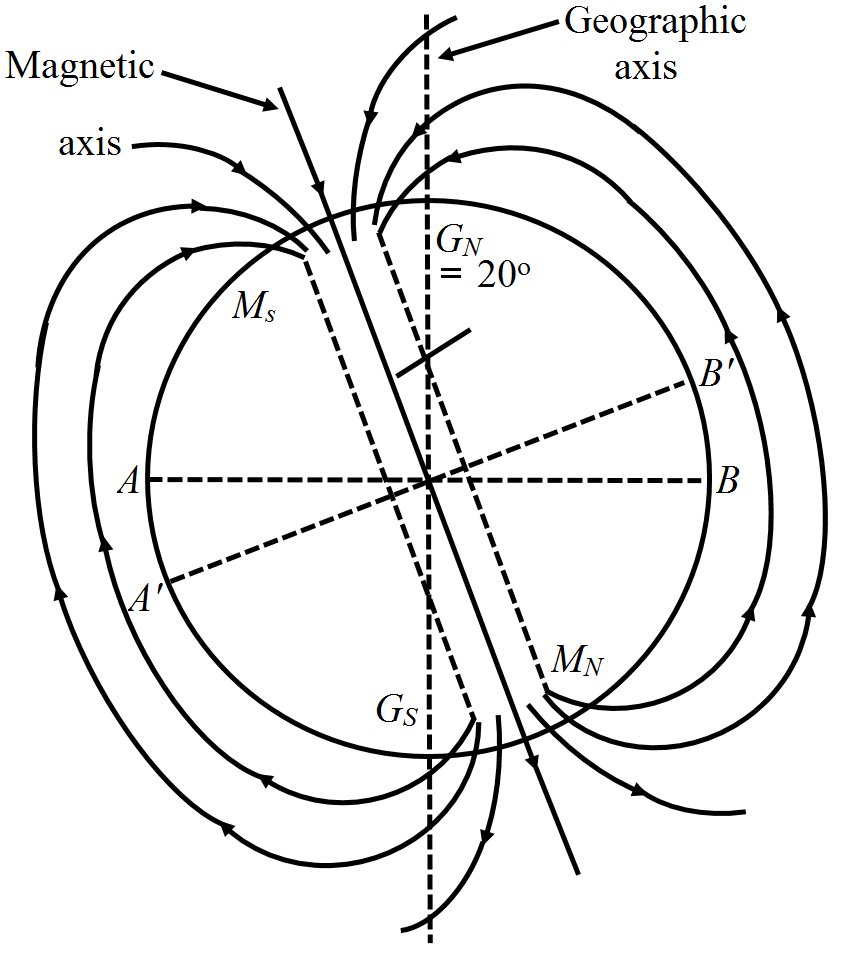
Assertion (A): The true geographic north direction is found by using a compass needle. Reason (R): The magnetic meridian of the earth is along the axis of rotation of the earth.

Answer

  1. A is false and R is also false.
Explanation:
From the compass we are able to know the poles.the north of compass points towards the magnetic south pole.

If we know the magnetic declination at that particular place (which is angle between geographic meridian and magnetic meridian) we can easily find out the true geographic north-south direction. Imaginary lines drawn along the earth's surface in the direction of the horizontal component of the magnetic field of the earth at all points passing through the north and south magnetic poles. This is similar to the longitudes of the earth, which pass through the geographic north and south poles.
 

Need a full question paper?

Generate a complete, print-ready paper with questions like this in minutes — across 16+ boards, with answer keys.

Start Generating Free

Similar questions

Assertion (A): Interference pattern is made by using yellow light instead of red light, the fringes becomes narrower. 
Reason (R): In Young's double slit experiment, fringe width is given by $\beta=\frac{\lambda D }{ d }$.
For question, statements are given-one labelled Assertion (A) and the other labelled Reason (R). Select the correct answer to these questions from the codes (a) (b) (c) and (d) as given below.
  1. Both A and R are true, and R is the correct explanation of A.
  2. Both A and R are true, but R is NOT the correct explanation of A.
  3. A is true, but R is false.
  4. A is false and R is also false.
Assertion (A): Density of all the nuclei is same.
Reason (R): Radius of nucleus is directly proportional to the cube root of mass number.
Two statements are given$-$one labelled Assertion $(A)$ and the other labelled Reason $(R)$. Select the correct answer to these questions from the codes $(a), (b), (c)$ and $(d)$ as given below.
Assertion: The focal length of an equiconvex lens placed in air is equal to radius of curvature of either face. Lens is made up of material of refractive index of $1.5.$
Reason: For an equiconvex lens, radius of curvature of both the faces is same.
Two statements are given-one labelled Assertion (A) and the other labelled Reason (R). Select the correct answer to these questions from the codes (a), (b), (c) and (d) as given below.
  1. Both A and R are true and R is the correct explanation of A.
  2. Both A and R are true but R is not the correct explanation of A.
  3. A is true but R is false.
  4. A is false and R is also false.
Assertion: A single lens produces a coloured image of an object illuminated by white light.
Reason: The refractive index of the material of lens is different for different wavelengths of light.
Two statements are given-one labelled Assertion (A) and the other labelled Reason (R). Select the correct answer to these questions from the codes (a), (b), (c) and (d) as given below.
  1. Both A and R are true and R is the correct explanation of A.
  2. Both A and R are true but R is not the correct explanation of A.
  3. A is true but R is false.
  4. A is false and R is also false.
Assertion: A convex lens is made of two different materials. A point object is placed on the principal axis. The number of images formed by the lens will be two.
Reason: The image formed by convex lens is always virtual.
Two statements are given-one labelled Assertion (A) and the other labelled Reason (R). Select the correct answer to these questions from thecodes(a), (b), (c) and (d) as given below.
  1. Both A and R are true and R is the correct explanation of A.
  2. Both A and R are true but R is not the correct explanation of A.
  3. A is true but R is false.
  4. A is false and R is also false.
Assertion: Diode lasers are used as optical sources in optical communicatiod.
Reason: Diode lasers consume less energy.
For two statements are given-one labelled Assertion (A) and the other labelled Reason (R). Select the correct answer to these questions from the codes (a), (b), (c) and (d) as given below.
  1. Both A and R are true, and R is the correct explanation of A.
  2. Both A and R are true, but R is not the correct explanation of A.
  3. A is true, but R is false.
  4. A is false, and R is also false.
Assertion: Material used in the construction of a standard resistance is constantan or manganin.
Reason: Temperature coefficient of constantan is very small.
For question two statements are given-one labelled Assertion (A) and the other labelled Reason (R). Select the correct answer to these questions from the codes (a), (b), (c) and (d) as given below.
  1. Both A and R are true and R is the correct explanation of A.
  2. Both A and R are true but R is NOT the correct explanation of A.
  3. A is true but R is false.
  4. A is false and R is also false.
Assertion (A): A narrow pulse of light is sent through a medium. The pulse will retain its shape as it travels through the medium.
Reason (R): A narrow pulse is made of harmonic waves with a large range of wavelengths.
Two statements are given $-$ one labelled Assertion $(A)$ and the other labelled Reason $(R)$. Select the correct answer to these questions from thecodes $(a), (b), (c)$ and $(d)$ as given below.
Assertion: Light Emitting Diode $(\text{LED})$ emit spontaneous radiation.
Reason: $\text{LED}$ are forward $-$ biased $p - n$ junction.
Two statements are given-one labelled Assertion (A) and the other labelled Reason (R). Select the correct answer to these questions from the codes (a), (b), (c) and (d) as given below.
  1. Both A and R are true and R is the correct explanation of A.
  2. Both A and R are true but R is not the correct explanation of A.
  3. A is true but R is false.
  4. A is false and R is also false.
Assertion: Infrared waves sometimes referred as heat waves.
Reason: Infrared waves heat up the earth surface.