MCQ
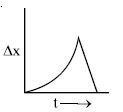
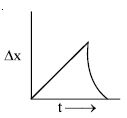
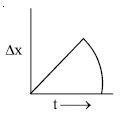
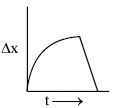
Two stones are thrown up vertically and simultaneously but with different speeds. Which graph correctly represents the time variation of their relative positions $\Delta x$.Assume that stones do not bounce after hitting ground.
  • A

  • B


  • D

Answer

Correct option: C.

c

Need a full question paper?

Generate a complete, print-ready paper with questions like this in minutes — across 16+ boards, with answer keys.
Start Generating Free

Similar questions

A closed organ pipe of length $l$ is sounded together with another closed organ pipe of length $l + x (x << l)$ both in fundamental mode. If $v$ = speed of sound, the beat frequency heard is
The rate of radiation of a black body at $0°C$ is $E\,J/sec$ . The rate of radiation of this black body at ${273^o}C$ will be
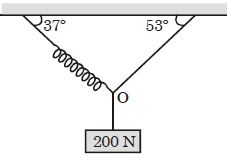
In the setup shown, a $200\, N$ block is supported in equilibrium with the help of strings  and a spring. A point $O$, the strings knotted. Extension in the spring is $4\, cm$. Force   constant of the spring is closest to ............ $N/m$ $[g = 10\, m/s^2]$
A soap bubble, having radius of $1\; \mathrm{mm}$, is blown from a detergent solution having a surface tension of $2.5 \times 10^{-2}\; N / m$. The pressure inside the bubble equals at a point $Z_{0}$ below the free surface of water in a container. Taking $g=10\; \mathrm{m} / \mathrm{s}^{2}$ density of water $=10^{3} \;\mathrm{kg} / \mathrm{m}^{3},$ the value of $\mathrm{Z}_{0}$ is......$cm$
The breaking stress of a wire of length $L$ and radius $r$ is $5$ $kg - wt/{m^2}$. The wire of length $2l$ and radius $2r$ of the same material will have breaking stress in $kg - wt/{m^2}$
The dimension ML-1 T-2 can correspond to:
  1. Moment of a force.
  2. Surface tension.
  3. Modulus of elasticity.
  4. Moefficient of viscosity.
The state of a thermodynamic system is represented by
A body of mass $5\, kg$ starts from the origin with an initial velocity $\overrightarrow {u\,} \, = \,30\hat i + 40\hat j\,m{s^{ - 1}}$. If a constant force $\overrightarrow {F\,} = - (\hat i + 5\hat j)N$ acts on the body, the time in which the y-component of the velocity becomes zero is ......... $\sec$
Length of a string tied to two rigid supports is $40 cm$. Maximum length (wavelength in $cm$) of a stationary wave produced on it is ... $cm$
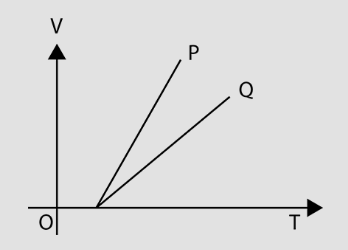
Figure shows the V−T graph for two particles P and Q. The relative velocity of P w.r.t. Q is: