Question
Two stones are thrown vertically upwards simultaneously with their initial velocities $u_1$ and $u_2$ respectively. Prove that the heights reached by them would be in the ratio of $\text{u}_1^2:\text{u}_2^1$ (Assume upward acceleration is $–g$ and downward acceleration to be $+g).$
Answer

We know for upward motion,  $\text{v}^2=\text{u}^2-2\text{gh}$ or $\text{h}=\frac{\text{u}^2-\text{v}^2}{2\text{g}}$
But at highest point $\text{v}=0$
Therefore, $\text{h}=\frac{\text{u}^2}{\text{g}}$
For first ball, $\text{h}_1=\text{u}_1\frac{2}{2\text{g}}$
And for second ball, $\text{h}_2=\frac{\text{u}^2_2}{2\text{g}}$
Thus, $\frac{\text{h}_1}{\text{h}_2}=\frac{\text{u}_1^2/2\text{g}}{\text{u}_2^2/2\text{g}}=\frac{\text{u}_1^1}{\text{u}_2^2}$ or $\text{h}_1:\text{h}_2=\text{u}_1^2:\text{u}_2^2$

Need a full question paper?

Generate a complete, print-ready paper with questions like this in minutes — across 16+ boards, with answer keys.

Start Generating Free

Similar questions

brief state what happens when:
Rheo leaves are boiled in water first and then a drop of sugar syrup is put on it?
When a gas jar containing air is inverted over a gas jar containing bromine vapour, the red-brown bromine vapour diffuse into air. Explain how bromine vapour diffuse into air.
A cheetah starts from rest, and accelerates at $2\ m/s^2$ for $10$ seconds. Calculate: The final velocity.
A wooden block is kept on a table top. The mass of the wooden block is $5\ kg$ and its dimensions are $40\ cm \times 20\ cm \times 10\ cm$. Find the pressure exerted by the wooden block on the table top if it is made to lie on the table top with its sides of dimensions, $(a)\  20\ cm \times 10\ cm$ and $(b) \ 40\ cm \times 20\ cm$.
A stone is thrown vertically upward with an initial velocity of $50\ m/s$. Take, $g$ as $10\ m/s^2$ Find the maximum height reached by the stone. What is the net displacement and the total distance covered by the stone?
Calculate the mass of sodium sulphate required to prepare its 20% (mass percent) solution in 100g of water?
Ice at 0°C is more effective in cooling than water at 0°C. Give reason.
For how long should a force of 100N act on a body of 20kg so that it acquires a velocity of 100m/s?
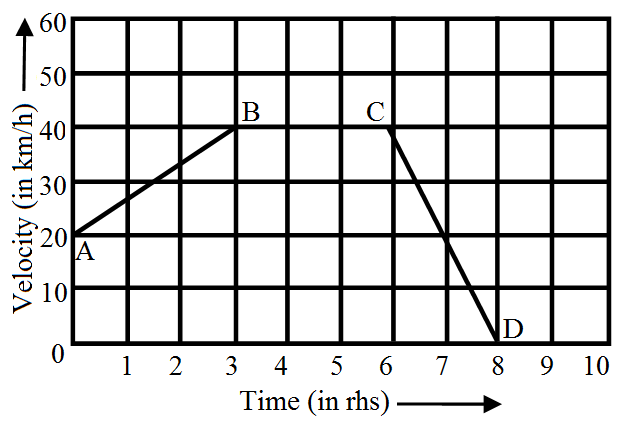
Given alongside is the velocity-tine graph for a moving body:

Find:
  1. Velocity of the body at point C.
  2. Acceleration acting on the body between A and B.
  3. Acceleration acting on the body between B and C.
An ant travels a distance of 8cm from P to Q and then moves a distance of 6cm at right angles to PQ. Find its resultant displacement.