MCQ
Two stones having different masses $m_1$ and $m_2$ are projected at an angle $\alpha$ and $\left(90^{\circ}-\alpha\right)$ with same speed from same point. The ratio of their maximum heights is
  • A
    $1: 1$
  • B
    $1: \tan \alpha$
  • C
    $\tan \alpha: 1$
  • $\tan ^2 \alpha: 1$

Answer

Correct option: D.
$\tan ^2 \alpha: 1$
d
(d)

$H \propto \sin \alpha$

$\therefore \quad \frac{H_1}{H_2}=\frac{\sin ^2 \alpha}{\sin ^2\left(90^{\circ}-\alpha\right)}=\tan ^2 \alpha$

Need a full question paper?

Generate a complete, print-ready paper with questions like this in minutes — across 16+ boards, with answer keys.

Start Generating Free

Similar questions

A block of mass $m$ is hung vertically from an elastic thread of force constant $\frac{{2mg}}{a}$ .Initially the thread was at its natural length and the block is allowed to fall freely. The work done on block by earth when it passes through the equilibrium position will be
The law showing the relation between the wavelength of highest emission of ideal black-body and temperature is :
Consider two uniform discs of the same thickness and different radii $R _{1}= R$ and $R _{2}=\alpha R$ made of the same material. If the ratio of their moments of inertia $I_{1}$ and $I_{2}$, respectively, about their axes is $I _{1}: I _{2}=1: 16$ then the value of $\alpha$ is
A bullet $10\,g$ leaves the barrel of gun with a velocity of $600\,m / s$. If the barrel of gun is $50\,cm$ long and mass of gun is $3\,kg$, then value of impulse supplied to the gun will be $.....\,Ns$
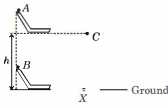
Three balls, $A, B$ and $C$ are released and all reach the point $X$ (shown in the figure). Balls $A$ and $B$ are released from two identical structures, one kept on the ground and the other at height $h$, from the ground as shown in the figure. They take time $t_A$ and $t_B$ respectively to reach $X$ (time starts after they leave the end of the horizontal portion of the structure). The ball $C$ is released from a point at height $h$, vertically above $X$ and reaches $X$ in time $t_C$. Choose the correct option.
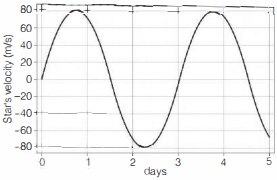
A star of mass $M$ (equal to the solar mass) with a planet (much smaller than the star) revolves around the star in a circular orbit. The velocity of the star with respect to the centre of mass of the star-planet system is shown below. The radius of the planet's orbit is closest to .......... $AU$ $(1 \,AU =$ Earth-Sun distance)
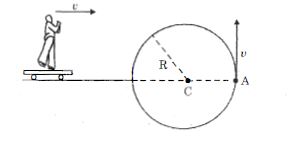
A boy is moving with a constant speed $v$ on a small trolley towards a distant circle as shown in the figure. A point mass is moving on the circle with a constant speed $v$, what is the frequency of change in magnitude of relative velocity of the point mass, as observed by the boy.
Two point masses having mass $m$ and $2 \,m$ are placed at distance $d$. The point on the line joining point masses, where gravitational field intensity is zero will be at distance ............
The temperature at which the reading of a Fahrenheit thermometer will be double that of centigrade thermometer is ........ $^o$
The amplitude of the vibrating particle due to superposition of two $SHMs,$

$y_1 = \sin \left( {\omega t + \frac{\pi }{3}} \right)$ and $y_2 = \sin \omega t$ is :