Question

Two straight horizontal parallel wires are carrying the same current in the same direction, d is the distance between the wires. You are provided with a small freely suspended magnetic needle. At which of the following positions will the orientation of the needle be independent of the magnitude of the current in the wires

(a) At a distance d/2  from any of the wires

(b) At a distance d/2  from any of the wires in the horizontal plane

(c) Anywhere on the circumference of a vertical circle of radius d and centre halfway between the wires

(d) At points halfway between the wires in the horizontal plane

Answer

(d) At points halfway between the wires in the horizontal plane

Need a full question paper?

Generate a complete, print-ready paper with questions like this in minutes — across 16+ boards, with answer keys.

Start Generating Free

Similar questions

The collector plate in an experiment on photoelectric effect is kept vertically above the emitter plate. Light source is put on and a saturation photocurrent is recorded. An electric field is switched on which has a vertically downward direction.
An ice cube is suspended in vacuum in a gravity free hall. As the ice melts it.
  1. Will retain its cubical shape.
  2. Will change its shape to spherical.
  3. Will fall down on the floor of the hall.
  4. Will fly up.
Consider the following two statements:
  1. Kirchhoff's junction law follows from conservation of charge.
  2. Kirchhoff's loop law follows from conservative nature of electric field.
The ratio of electric force and gravitational force between a proton and electron is:
To reduce the reasonant frequency in an LCR series circuit with a generator:
An inductor coil of some resistance is connected to an AC source. Which of the following quantities have zero average value over a cycle?

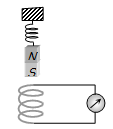
A magnet NS is suspended from a spring and while it oscillates, the magnet moves in and out of the coil C. The coil is connected to a galvanometer G. Then as the magnet oscillates,

(a) G shows deflection to the left and right with constant amplitude

(b) G shows deflection on one side

(c) G shows no deflection.

(d) G shows deflection to the left and right but the amplitude steadily decreases.

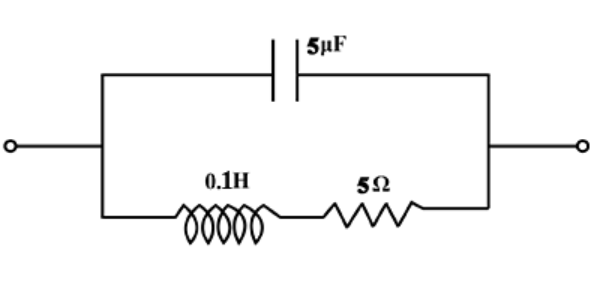
In the circuit shown in fig., the resonant frequency is.
Image

An electric lamp is marked 60 W, 230 V. The cost of 1 kilowatt hour of power is Rs. 1.25. The cost of using this lamp for 8 hours is

(a) Rs. 1.20

(b) Rs. 4.00


(c) Rs. 0.25

(d) Rs. 0.60

Assertion  :   A laser beam 0.2 W power can drill holes through a metal sheet, whereas 1000 W torch-light cannot.   

Reason     : The frequency of laser light is much higher then that of torch light.

(a) If both assertion and reason are true and the reason is the correct explanation of the assertion.

(b) If both assertion and reason are true but reason is not the correct explanation of the assertion.

(c) If assertion is true but reason is false.

(d) If the assertion and reason both are false.