Question
Two streams of electrons are moving parallel to each other in the same direction. They_____.

Answer

  1. Repel each other.
Explanation:
If the beams were stationary, they'd repel (because negative charges repel).
Once the beams are moving we get the magnetic effects in addition, which reduces the repulsion.
The magnetic attraction only becomes strong enough to cancel the electric repulsion at c.
Therefore the streams will repel each other due to electric repulsion.

Need a full question paper?

Generate a complete, print-ready paper with questions like this in minutes — across 16+ boards, with answer keys.
Start Generating Free

Similar questions

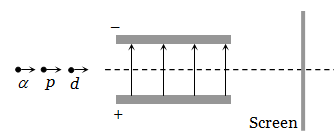
A proton, a deutron and an $a-$particle having the same momentum, enters a region of uniform electric field between the parallel plates of a capacitor. The electric field is perpendicular to the initial path of the particles. Then the ratio of deflections suffered by them is
       
Cathode rays are similar to visible light rays in that(a) They both can be deflected by electric and magnetic fields(b) They both have a definite magnitude of wavelength(b) They both have a definite magnitude of wavelength(d) They both can expose a photographic plate


An inductance $L$ and a resistance $R$ are first connected to a battery. After some time the battery is disconnected but $L$ and $R$ remain connected in a closed circuit. Then the current reduces to $37\%$ of its initial value in
Potential due to charge q at its own location is:
The energy contained in a small volume through which an electromagnetic wave is passing oscillates with:
  1. Zero frequency.
  2. The frequency of the wave.
  3. Half the frequency of the wave.
  4. Double the frequency of the wave.
Two resistance A and B are made up of same substance. Length and radius of wire A is twice that of B. Ratio of resistances of A and B are:
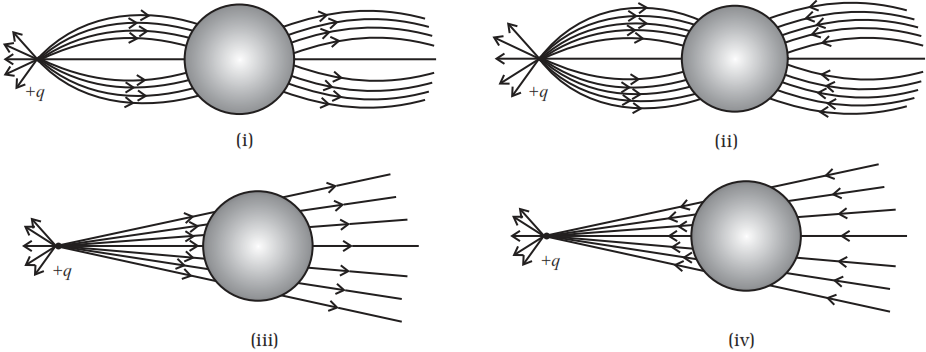
A point positive charge is brought near an isolated conducting sphere. The electric field is best given by:
Moment of inertia of a magnetic needle is $40 \ \mathrm{gm}-\mathrm{cm}^2$ has time period $3$ seconds in earth's horizontal field $=3.6 \times 10^{-5}$ weber $/ \mathrm{m}^2.$ Its magnetic moment will be
 
Two copper balls, each weighing $10 g$ are kept in air $10 \ cm$ apart. If one electron from every $10^6$ atoms is transferred from one ball to the other, the coulomb force between them is (atomic weight of copper is $63.5)$
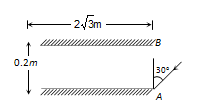
Two plane mirrors. $A$ and $B$ are aligned parallel to each other, as shown in the figure. A light ray is incident at an angle of $30^\circ$ at a point just inside one end of $A.$ The plane of incidence coincides with the plane of the figure. The maximum number of times the ray undergoes reflections $($including the first one$)$ before it emerges out is