MCQ
Two thin blankets keep more hotness than one blanket of thickness equal to these two. The reason is
  • A
    Their surface area increases
  • A layer of air is formed between these two blankets, which is bad conductor
  • C
    These have more wool
  • D
    They absorb more heat from outside

Answer

Correct option: B.
A layer of air is formed between these two blankets, which is bad conductor
(b)

Need a full question paper?

Generate a complete, print-ready paper with questions like this in minutes — across 16+ boards, with answer keys.

Start Generating Free

Similar questions

Two cells of equal e.m.f. and of internal resistances $r_1$ and $r_2\left(r_1>r_2\right)$ are connected in series. On connecting this combination to an external resistance $R$, it is observed that the potential difference across the first cell becomes zero. The value of $R$ will be
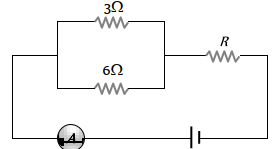
If the ammeter in the given circuit reads $2 A$, the resistance $R$ is

Image

A body is executing Simple Harmonic Motion. At a displacement $x$ its potential energy is $E_1$ and at a displacement $y$ its potential energy is $E_2$. The potential energy $E$ at displacement $(x+y)$ is
Two coherent sources of different intensities send waves which interfere. The ratio of maximum intensity to the minimum intensity is $25.$ The intensities of the sources are in the ratio
A cylinder of height $20 m$ is completely filled with water. The velocity of efflux of water (in $m / s$ ) through a small hole on the side wall of the cylinder near its bottom is
Two rods of different materials having coefficients of linear expansion $\alpha_1, \alpha_2$ and Young's moduli $Y_1$ and $Y_2$ respectively are fixed between two rigid massive walls. The rods are heated such that they undergo the same increase in temperature. There is no bending of rods. If $\alpha_1: \alpha_2=2: 3$, the thermal stresses developed in the two rods are equally provided $Y_1: Y_2$ is equal to
When light is refracted from air into glass
A force $(\vec{F})=3 \hat{i}+\hat{c j}+2 \hat{k}$ acting on a particle causes a displacement: $(\vec{s})=-4 \hat{i}+2 \hat{j}+3 \hat{k}$ in its own direction. If the work done is $6 J$, then the value of ' $c$ ' is
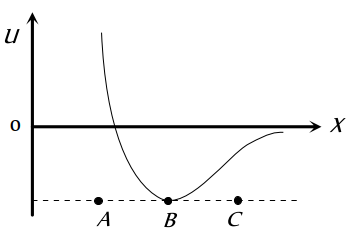
The potential energy $U$ between two molecules as a function of the distance $X$ between them has been shown in the figure. The two molecules are

Image

The instantaneous velocity of a body can be measured