Question

Two thin wire rings each having a radius R are placed at  a distance d apart with their axes coinciding. The charges on the two rings are +q  and -q. The potential difference between the centres of the two rings is

(a) Zero  

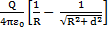
(b)

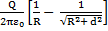
(c)

(d)

Answer

(d)

Need a full question paper?

Generate a complete, print-ready paper with questions like this in minutes — across 16+ boards, with answer keys.

Start Generating Free

Similar questions

A cylindrical tube, open at both ends, has a fundamental frequency v. The tube is dipped vertically in water so that half of its length is inside the water. The new fundamental frequency is:

  1. $\frac{\text{v}}{4}$

  2. $\frac{\text{v}}{2}$

  3. $\text{v}$

  4. $2\text{v}$

Six protons and six neutrons are brought together to form a carbon nucleus, but the mass of the carbon nucleus is less than the sum of the masses of the individual particles due to the mass defect, This deducted mass has been:
A train is moving towards north with a speed of 180 kilometers per hour. If the vertical component of the earths magnetic filed is 0.2 × 10⁻⁴ T, the emf induced in the axle of length 1.5m is

An electron is moving towards x-axis. An electric field is along y-direction then path of electron is

(a) Circular

(b) Elliptical

(c) Parabola

(d) None of these

The frequency of a light ray is 6 . Its frequency when it propagates in a medium of refractive index 1.5, will be

(a) 1.67  

(b) 9.10  

(c) 6  

(d) 4  

A straight wire carrying a current 10 A is bent into a semicircular arc of radius 5 cm. The magnitude of magnetic field at the center is

(a) 1.5  

(b) 3.14  

(c) 6.28  

(d)  19.6  

A two metre wire is moving with a velocity of 1 m/sec perpendicular to a magnetic field of 0.5 weber/m2. The e.m.f. induced in it will be

(a) 0.5 volt

(b) 0.1 volt

(c) 1 volt 

(d) 2 volt

Sound waves in air cannot be polarized because:

By corpuscular theory of light, the phenomenon which can be explained is

(a) Refraction

(b) Interference

(c) Diffraction

(d) Polarisation

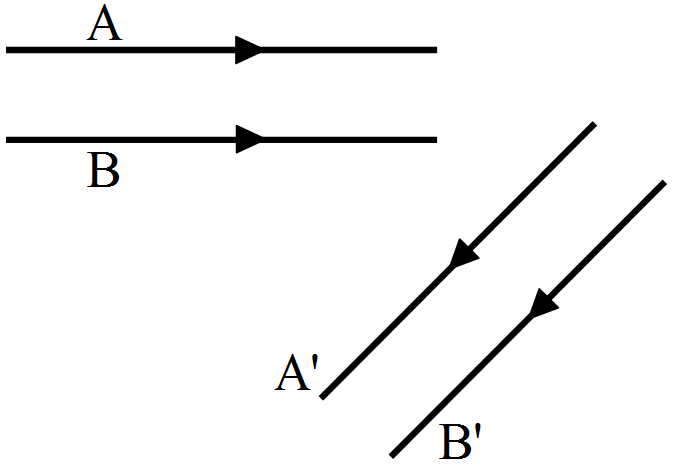
Two rays A and B being reflected by a mirror and going as A' and B'. The mirror: