MCQ
Two trains are moving with equal speed in opposite directions along two parallel railway tracks. If the wind is blowing with speed $u$ along the track so that the relative velocities of the trains with respect to the wind are in the ratio of $1:2$, then the speed of each train must be
  • $3u$
  • B
    $2u$
  • C
    $4u$
  • D
    $u$

Answer

Correct option: A.
$3u$
a
Let the speed of trains be $x$

$\therefore \frac{x-u}{x+u}=\frac{1}{2}$ or $2 x-2 u=x+u$

or $x=3 u$

Need a full question paper?

Generate a complete, print-ready paper with questions like this in minutes — across 16+ boards, with answer keys.

Start Generating Free

Similar questions

A truck of mass $10,000\, kg$ moves up an inclined plane rising $1$ in $50$ with a speed of $36\, km/h$. Find the power of engine .................. $\mathrm{kW}$  $(g = 10\, m/s^2$)
A particle of mass $m$ is thrown horizontally from the top of a tower and another particle of mass $2 \,m$ is thrown vertically upward. The acceleration of centre of mass is .............
A body, thrown upwards with some velocity, reaches the maximum height of $20\,m$. Another body with double the mass thrown up, with double initial velocity will reach a maximum height of..........$m$
A p-type semiconductor is:
A closed organ pipe has a fundamental frequency of $1.5\, kHz$. The number of overtones that can be distinctly heard by a person with this organ pipe will be : (Assume that the highest frequency a person can hear is $20,000\, Hz$)
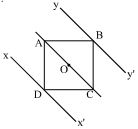
Let $I_1, I_2$ and $I_3$ be the moment of inertia of a uniform square plate about axes $AOC, xDx'$ and $yBy'$ respectively as shown in the figure. The moments of inertia of the plate $I_1 : I_2 : I_3$ are in the ratio.
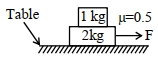
The coefficient of static friction between two blocks is $0.5$ and the table is smooth. The maximum horizontal force that can be applied to move the blocks together is $\ldots \ldots . N$. (take $\left.g=10\, {ms}^{-2}\right)$
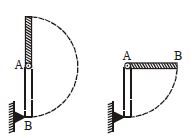
A rod $AB$ is free to rotate in a vertical plane about a horizontal axis through $A$ as shown in figure. It is slightly disturbed from rest in its position of unstable equilibrium and when it is next vertical the end $B$ collides with a fixed peg and rebounds. If the rod comes to instantaneous rest when $AB$ is horizontal (as shown in figure) then :-
Consider two observers moving with respect to each other at a speed $v$ along a straight line. They observe a block of mass $m$ moving a distance $l$ on a rough surface. The following quantities will be same as observed by the two observers.
$A$ and $B$ start walking towards each other from the opposite ends of a $15\ km$ long straight road, at a speed of $5\ km/ hr$ and $7\ km/ hr$ respectively. How far apart will they be after one hour?