Question
Two transparent slabs having equal thickness but different refractive indices $\mu_1$ and $\mu_2$ are pasted side by side to form a composite slab. This slab is placed just after the double slit in a Young's experiment so that the light from one slit goes through one material and the light from the other slit goes through the other material. What should be the minimum thickness of the slab so that there is a minimum at the point $P_0$ which is equidistant from the slits?
Answer

The change in path difference due to the two slabs is $(\mu_1-\mu_2) ($as in problem no. $16).$
For having a minimum at $P_0$, the path difference should change by $\frac{\lambda}{2}.$
So, $\Rightarrow\frac{\lambda}{2}=(\mu_1-\mu_2)\text{t}\Rightarrow\text{t}=\frac{\lambda}{2(\mu_1-\mu_2)}.$

Need a full question paper?

Generate a complete, print-ready paper with questions like this in minutes — across 16+ boards, with answer keys.

Start Generating Free

Similar questions

The photoelectric cut-off voltage in a certain experiment is 1.5 V. What is the maximum kinetic energy of photoelectron emitted?
A concave lens is placed in water. Will there be any change in focal length? Give reason.
A Young's double slit apparatus has slits separated by $0.28\ mm$ and a screen 4$8\ cm$ away from the slits. The whole apparatus is immersed in water and the slits are illuminated by the red light $(\lambda=700\ nm$ in vacuum$)$. Find the fringe$-$width of the pattern formed on the screen.
Find the potential energy of a system made up of three point charges.
$1 F\ ($farad$)$ is a very large unit for practical purposes. Explain with example.
Prove $n_e \cdot n_h=n_i^2$ for $n-$type and $p-$type semiconductors where,
$n_e -$ number density of electrons
$n_h -$ number density of holes
$n_i - $ number density of intrinsic charge carriers
What will be the effect on inductive reactance XL and capacitive reactance XC if frequency of ac source is increased?
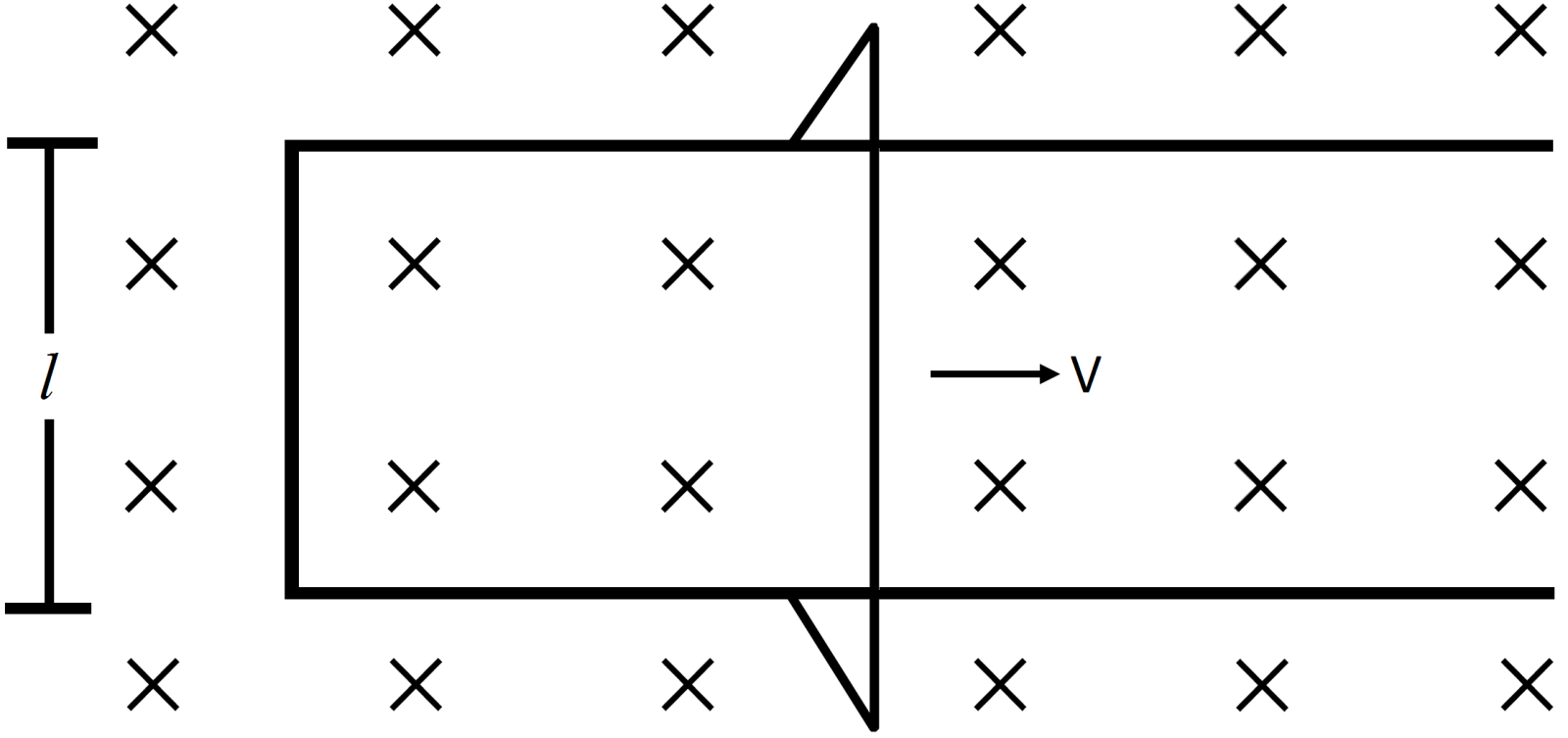
Figure shows a long U-shaped wire of width l placed in a perpendicular magnetic field B. A wire of length l is slid on the U-shaped wire with a constant velocity v towards right. The resistance of all the wires is r per unit length. At t = 0, the sliding wire is close to the left edge of the U-shaped wire. Draw an equivalent circuit diagram, showing the induced emf as a battery. Calculate the current in the circuit.
A heavy mass m is hanging from a string in equilibrium without breaking it. When this same mass is set into oscillation, the string breaks. Explain.
If $\overrightarrow{\text{A}}\times\overrightarrow{\text{B}}=0,$ can you say that:
  1. $\overrightarrow{\text{A}}=\overrightarrow{\text{B}}$
  2. $\overrightarrow{\text{A}}\neq\overrightarrow{\text{B}}$