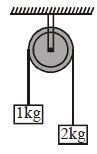
- A$\frac{1}{4}sec$
- B$\frac{1}{2}sec$
- C$\frac{2}{3}sec$
- ✓$\frac{1}{3}sec$
Mass being pulled $=2+1=3 \mathrm{kg}$
Acceleration of the system is,
$a=\frac{10}{3} \mathrm{m} / \mathrm{s}^{2}$
Velocity of both the blocks at $t=1$ s will be.
$v_{0}=a t=\frac{10}{3} \times 1=\frac{10}{3} \mathrm{m} / \mathrm{s}$
Now at this moment, velocity of $2\, kg$ block becomes zero, while that of $1 \mathrm{kg}$ block is
$\frac{10}{3} \mathrm{m} / \mathrm{s}$ upwards. Hence, string becomes tight
again when
displacement of $1 \mathrm{kg}$ block $=$ displacement of $2 \mathrm{kg}$ block
or $\quad v_{0} t-\frac{1}{2} g t^{2}=\frac{1}{2} g t^{2}$
$\mathrm{t}=\frac{\mathrm{v}_{0}}{\mathrm{g}}=\frac{(10 / 3)}{10}=\frac{1}{3} \mathrm{sec}$
Generate a complete, print-ready paper with questions like this in minutes — across 16+ boards, with answer keys.

If two springs $S_1$ and $S_2$ of force constants $k_1$ and $k_2$, respectively, are stretched by the same force, it is found that more work is done on spring $S_1$ than on spring $S_2$.
STATEMENT 1 : If stretched by the same amount work
done on $S_1$, Work done on $S_1$ is more than $S_2$
STATEMENT2: $k_1 < k_2$